

I bought the MINOLL back stretcher in the first week of October, five weeks ago as I write this, and I have used it often enough to have an opinion that is not just excitement about a new gadget. I am 67, retired after thirty-four years as a commercial airline mechanic, and I walk three rounds a week on a public course south of Knoxville. My lower back has been stiff and achy since about age 60, worst on the first tee and the morning after a round. My doctor looked at it, said it was ordinary wear and muscle tightness rather than a disc problem, and told me to stay active, warm up, and strengthen my core. No surgery, no injections, nothing dramatic. That is the whole medical file.
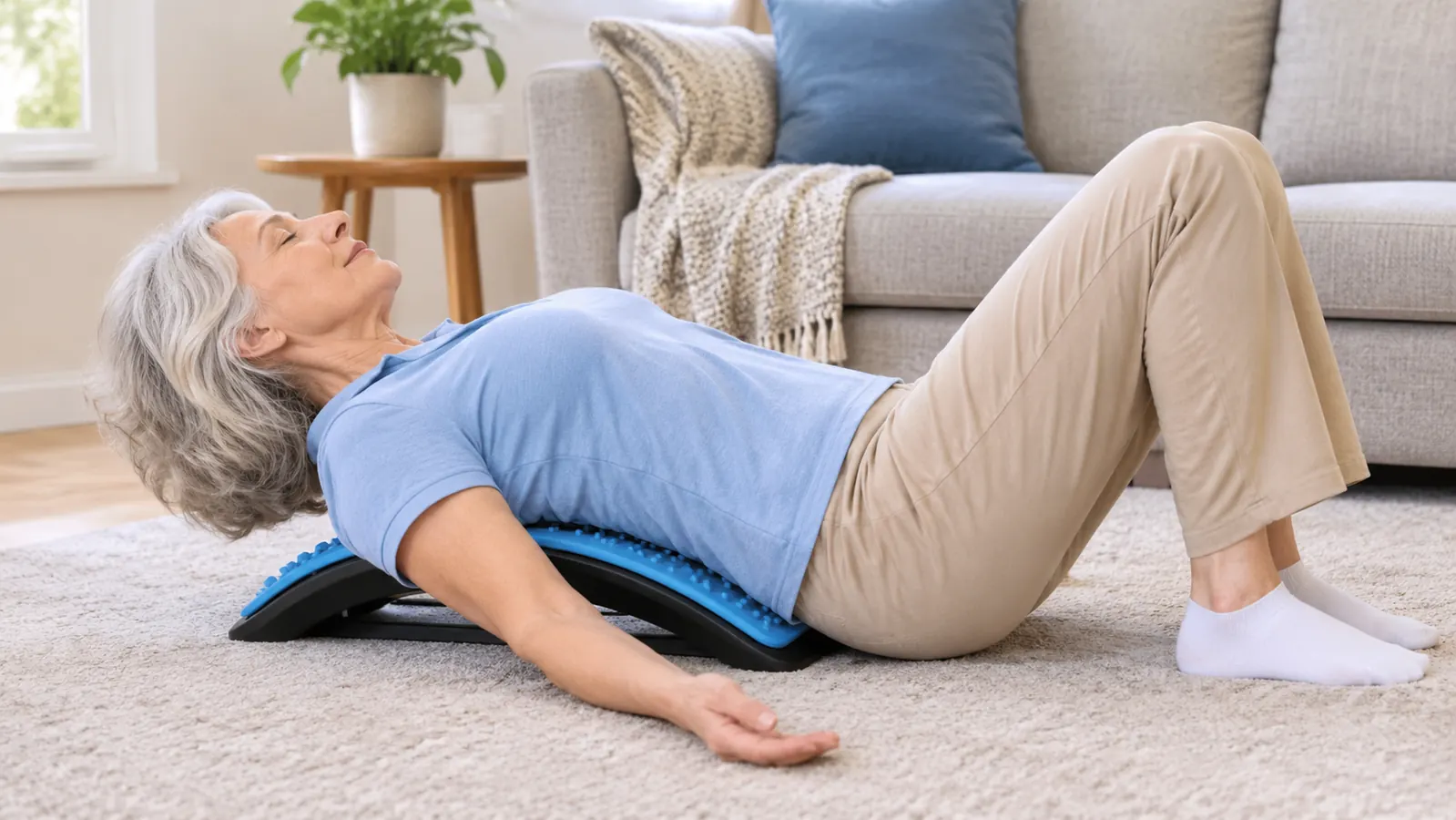
So let me be plain about what this is. It is a molded arch with several height settings, about two pounds, and you lie back over it on the floor for a few minutes. That is the entire product. What nobody tells you before you buy one is that the device is the easy part and the learning is the hard part: where to put it under your back, which height to start on, how long to stay, and how to get up again without undoing whatever you just did. Get those wrong and you will decide the thing is junk when the truth is you used it wrong.
The Quick Verdict
A useful five minute tool for an ordinary stiff lower back, provided you start on the lowest arch and treat it as a habit rather than a fix.
Amazon Check Today's Price →Five weeks in, this is the one I would buy again
Multiple arch settings, about two pounds, and it slides under the sofa when I am done. Today's price and the full listing are on Amazon.
Amazon Check Today's Price on Amazon →What Nobody Tells You Before You Buy
The reviews I read before ordering were mostly people saying it changed their life or people saying it was painful and useless. Both are true depending on the day and the height setting, and neither one tells you how to use it. The listing itself is thin on the part that matters. It says five to ten minutes, twice a day, and it says the arch is adjustable. It does not say that the lowest setting is the only one a stiff back should touch for the first week, or that lying down on a hard floor in a cold room is a different experience from doing it on carpet in a warm one.
Here is the other thing. A back stretcher is a passive stretch. You lie there and the arch does the work. That means it does nothing for the muscles that actually hold your spine up, which is what my physical therapist spent the better part of three years telling me. The board bought me a few minutes of relief and a reason to get on the floor every evening. The core work is what keeps my back from seizing up on the back nine. If you are expecting the board alone to carry you, you will be disappointed by week three.
How I Have Actually Used It
Early October, first week. I unboxed it in the living room, set it on the carpet with the lowest arch facing up, and lay back on it with my knees bent and my feet flat, which is how my physical therapist taught me to lie on the floor years ago. I stayed three minutes. It was not comfortable in any way I would describe as pleasant. It was a firm pressure under my lower back and a stretch I could feel through my hips, and when I rolled off I was looser than when I got down. That was enough to keep going.
For the first two weeks I did three minutes on the lowest setting, once a day, usually right after a round while I was still in my golf clothes, and sometimes in the evening if the day had been long. Around the middle of October I moved to the middle arch. That was a noticeable step up, and the first time I did four minutes on it I felt my lower back for an hour afterward, not pain exactly, more like the feeling after a deep stretch. I backed off to three minutes and stayed there. Five weeks in, three to five minutes on the middle setting is the routine.
Twice a day, as the listing suggests, has not happened. I will be honest about that. I do it after every round, three times a week, and maybe two other evenings. Carol has pointed out that this is exactly how I handle every exercise routine, and she is right. The difference here is that it is short enough that I actually do it, which is more than I can say for the sheet of stretches that has been taped inside a cabinet door since 2023.
Three minutes on the lowest arch, right after a round, and I can get my golf shoes off without the grunt. That is the whole claim I am making.
Comfort Is the Whole Story, and It Is Not What You Expect
Nobody warns you that the first thirty seconds are the worst. You lie back, the arch presses into the muscles on either side of your spine, and your body says no. The instinct is to hold yourself half off it, which means you are bracing with the exact muscles you are trying to relax. I learned to breathe out and let my full weight settle instead. That one change meant the difference between three minutes of dread and three minutes I could stand. If you fight the arch, you will hate it and you will quit in a week. If you let go, it does its job.
Comfort also depends on where you put the thing. Too high, up under the ribs, and it feels like a fist in your diaphragm. Too low, down at the tailbone, and you get nothing at all. For me the right spot is the arch directly under the belt line, with my knees bent and my feet flat on the carpet. I found it by sliding the board an inch at a time over about a week. Nobody can find it for you over the internet. You have to hunt for it yourself.
The materials matter less than I expected. The listing says the body is a hard plastic with foam on the contact surfaces, and that is what it feels like, a firm foam sitting over a rigid arch. It does not dig in at the edges the way bare plastic would. I would not call it plush and I would not want to lie on it for twenty minutes. At three to five minutes it is fine. Much past that my back starts to complain and I stop. The five to ten minute window in the listing is, in my experience, generous.
Fit: Where It Works and Where It Does Not
I am six feet even and about 205 pounds, and the arch fits my lower back comfortably. Carol is five foot four, tried it once, and said it felt like it was built for a bigger person, that the arch reached too far up her back to sit where she wanted it. That is worth knowing before you order. This is one fixed arch with height adjustment, not a custom fit, so body length changes where the pressure lands. Longer backs will find it more forgiving than shorter ones.
Fit is also about the floor. I use it on the living room carpet, which has a little give. The one time I tried it on the concrete in the garage, everything got sharper and less forgiving, and I did not repeat the experiment. A rug or a mat makes the same arch feel like a different product, and that costs nothing to test. If you have hardwood throughout the house and no rug anywhere, plan on picking up a cheap exercise mat.
The portability claim is real. The MINOLL board is about two pounds and it slides under the sofa or stands on end in the closet, so it does not become furniture the way exercise equipment usually does. I keep mine beside the fireplace and it has not turned into an obstacle for anybody. It would ride in the back of the CR-V next to the folded push cart without any trouble, though in five weeks I have not had a reason to take it anywhere.
What I Liked
- Short enough to actually keep up with: three to five minutes is easy to fit into an evening
- Multiple arch heights let you build up instead of starting too hard
- About two pounds and it stores flat, so it does not become furniture
- Firm foam over the arch takes the edge off the hard plastic underneath
Where It Falls Short
- The first thirty seconds are unpleasant, and the wrong height is worse than nothing
- Passive stretch only, it does nothing for the muscles that hold your spine up
- One fixed arch, so body length changes where the pressure actually lands
- Needs a rug or a mat, and a hard floor makes it much less forgiving
Compared to Just Lying on the Floor, Which Was the Old Routine
Before early October, my evening routine was lying on the carpet with my knees bent and my feet flat, which is what my physical therapist taught me. That is free and it is not nothing. What the arch adds is a stretch in the other direction, an extension instead of a neutral lie. For my particular stiff back, that turned out to matter. The neutral lie loosened the muscles. The arch opened something up that the neutral lie was not reaching.
Would I spend the money on that difference again? Yes, and I would do it in October rather than waiting until the season ended. But I want to be straight with you that the free version got me most of the way and the board got me the last part. If things are tight, lie on the floor with your knees bent for five minutes a night and put the board on a wish list. If the free version stops helping, which is what happened to me around late summer, that is when the arch earns its keep.

The Limits Nobody Puts on the Box
This does not fix anything. I want to be careful here because the listing language gets enthusiastic and I am not a doctor. What I can tell you is what happened to me. My back is less stiff when I get out of bed the morning after a round than it was in September. That is a real change and I am glad of it. It is also a change that sits alongside a heating pad most evenings, a brace on cold mornings, a warm-up stick in the parking lot, and the core routine my physical therapist gave me. Take any one of those away, the stretcher included, and I would still be roughly where I am.
The other limit is that it does nothing while you are on your feet. My trouble is on the first tee and the morning after. The stretcher helps the morning after. It cannot help the first tee, because I am not lying on it at the first tee. That is the gap the warm-up fills, and it took me a while to understand that these are two different jobs. A back stretcher is an evening tool. Do not buy it expecting to feel different walking to the tee box.
And be honest with yourself about the difference between an ache and an alarm. My doctor was clear that ordinary stiffness from wear and from three hours on my feet is one thing. Sharp pain, pain that runs down a leg, numbness, or a back that does not settle after a few days is another thing entirely, and it is not a job for a piece of plastic on the living room floor. If that is where you are, close the browser and call your doctor. I mean that with no hedging at all.
Who This Is For
This is for the golfer with an ordinary stiff lower back, the kind that loosens after ten minutes of moving around and stiffens again the next morning. It is for someone who walks the course and feels it in the evening, and who has been told by a doctor that it is wear and muscle tightness and to stay active. It is for someone who will actually get down on the floor for three minutes, because if you will not, the best arch ever molded is a doorstop with extra steps.
It is also for the person who wants a small, low commitment thing to try alongside the work they are already doing, not a replacement for it. In my case the work I am already doing is the core exercises from my physical therapist, a heating pad in the recliner, and a brace on the cold mornings. The MINOLL board is the newest piece and the one I reach for after a round. It earns its place in that lineup. It does not replace anything in it.
Who Should Skip It
Skip it if your pain is sharp, new, or travels down your leg. Skip it if a doctor has told you that you have a disc issue, a fracture, or anything structural, because a hard arch under the spine is not something to experiment with on your own. Skip it if getting down on the floor and back up again is a struggle, since the whole product requires exactly that and no amount of good intentions changes it. And skip it if you are looking for something that works while you sit at a desk, because it does not.
Skip it too if you want a firm answer on the first day. The first few sessions are the worst ones and the benefit builds over a couple of weeks, which is a long time if you were hoping to be impressed right away. My first three minutes were not impressive at all. I kept going because the rest of the day felt better, not because the three minutes felt good. If that trade does not appeal to you, save your money for something else.
What I Would Tell You in the Clubhouse Grill
Five weeks is not a long time and I am not going to oversell it. What I can say is that the MINOLL board has become part of the after-round routine the same way the cart and the heating pad did, and that it is the shortest part of that routine by a wide margin. Three to five minutes on the middle arch on the living room carpet, most evenings I play. My back is less cranky the next morning. That is the claim, no more and no less.
If you buy one, start on the lowest setting and stay there a week even if it feels like nothing is happening. Find the spot under your belt line by sliding it an inch at a time. Breathe out and let your weight settle instead of bracing against it. Get up slowly, roll to your side first, and use your arms. And keep doing whatever your physical therapist told you, because the board is a five minute stretch and nothing more than that. It is a good five minutes. It is not the whole answer.
The five minute habit I kept past week three
Multiple arch settings, about two pounds, and it stores flat beside the fireplace. Today's price and the full listing are on Amazon.
Amazon Check Today's Price on Amazon →