

The first tee at our course sits in a low spot where the frost hangs on until nine. On the last Saturday in March I stood there with both hands on my knees, trying to talk my lower back into cooperating, and it was not interested. I spent thirty-four years walking on concrete around commercial aircraft before I retired, and my lower back has been stiff and achy since about the time I turned sixty. My doctor has looked at it more than once. His read is ordinary wear and muscle tightness, not a disc problem, and his advice has not changed: stay active, warm up before you play, keep strengthening your core. That week I ordered the MUELLER Sports Medicine Lumbar Back Brace with the removable pad, and I have worn it through the whole 2026 season since.
Eight months now, three rounds a week, walking every one of them. I am not a doctor, a physical therapist or a golf pro, and I am not going to tell you this brace repaired anything. It is a piece of equipment, the same as the push cart I have been using since April of last year, and what I can tell you is what it actually did out on the course, what it did not do, and who I think should bother.
The Quick Verdict
It holds a stiff lower back steady on a cold morning and on the round after a sore day, and the four steel springs are real support rather than padding. It is a support, not a repair, and it earns its space in the bag.
Amazon Check Today's Price →A cold first tee is a support problem before it is a swing problem
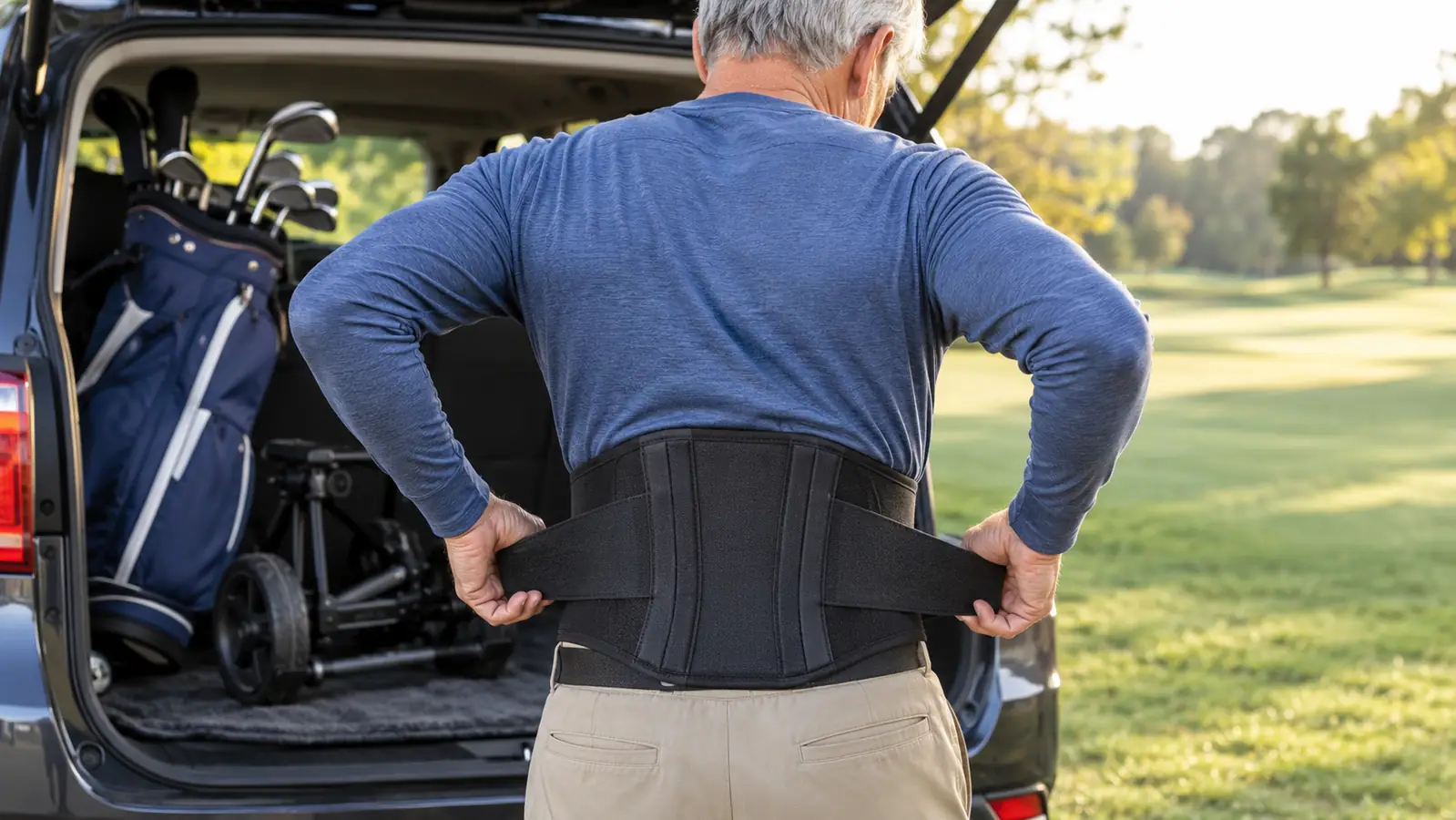
Four steel springs, a removable pad, and an adjustable fit that runs from a 28 inch waist to a 50 inch waist in the Regular size. It goes on over a thin base layer in about twenty seconds.
Amazon Check Today's Price on Amazon →How I've Used It
I bought it in March 2026, right after that Saturday, and it was in my hands before the next Thursday game. First time out I wore it over a thin long sleeve base layer, set so the bottom edge sat just below my belt line and the top reached about the middle of my back. That is where my stiffness lives, low and across, and that is where I wanted the pressure. Twenty seconds to put on, maybe fifteen more to get it to the snugness I wanted, and then I walked out to the first tee and forgot about it until the fourth hole.
There was one Sunday in the middle of April that I still think about. We had a frost delay, the temperature never got past forty-four all morning, and I wore it the whole eighteen for the only time all season. I shot 88, which on a cold day with a two hour delay is a good number for me, and more to the point I did not spend the back nine thinking about my back. That is the difference I paid for, and it is a difference I can point at on a scorecard and a calendar.
I do not wear it every round. My rule came together over the season and it has not changed. I wear it on cold mornings, meaning anything under about fifty degrees at the first tee. I wear it the round after a day my back was sore, which for me is usually the day after a long walking round in soft ground. And I wear it on the days I know I am playing thirty-six, which happens maybe twice a season with the Thursday group. Every other round it stays in the side pocket of my bag.
On the course I loosen it between shots once the morning warms up, usually around the fourth or fifth hole, and I take it off altogether at the turn if it is above seventy. It goes back into the bag, not into the car, because I want it with me if the back tightens on the back nine. On the range I wear it for the first ten minutes of the warm-up and then take it off, because the slow swings my physical therapist gave me are easier to do without it.
One thing I did first. I asked my doctor whether wearing a brace for a round was fine, and he said it was fine as support as long as I kept up the core exercises and did not use it as a reason to skip them. That was the right order to do things in, and I would say the same to anybody in my foursome. Before this I had never owned a brace of any kind. Not for golf, not for the years I spent on the ramp, not for anything.
What This Brace Actually Is
The listing is short and specific, which I appreciate in a product. Four steel springs sit inside the back of it and deliver what the listing calls firm, targeted compression. That matches what I feel. This is not a foam pad with a strap around it. When you pull it snug, you can feel the springs pressing along the muscles on either side of your spine, and that pressure is the whole reason I put it on. There is also a removable pad that comes with it. I left mine in.
Something I checked before ordering, because I read the paperwork on everything. The listing says MUELLER has been in sports medicine for over sixty years, and what arrived was one brace in a box with nothing to assemble and no separate pieces to lose. I spent thirty-four years around equipment that came with a manual, and I have come to value the opposite. This is a thing you take out of the box, put around your waist and pull snug.
The material is a polyester and neoprene blend, and the listing puts the weight at 16 ounces. A pound, roughly the weight of the water bottle I keep in the cart. It is listed as adjustable, stretchable, lightweight and odor resistant. After eight months of East Tennessee summers the odor part has held up better than I expected, though I do wipe it down and let it air out after every round I wear it. That is just how I treat anything that lives in a golf bag.
Sizing is where I would slow down if I were you. The listing says to measure around the widest part of your waist, and it gives Small at 22 to 30 inches and Regular at 28 to 50 inches, with a Plus size beyond that. I measured 40 inches around, which put me in the middle of the Regular, and the Regular has been right all season. There is a lot of adjustment in it, so the Regular covers a wide spread of people. Measure, do not guess, and for goodness sake do not order by your pants size.
What it is not: there is no dial, no pump, nothing to inflate and nothing to charge. You pull it snug and that is the entire interaction. If you are expecting something that adjusts itself or reports back to you, this is not that, and I would rather tell you now than have you find out on the first tee. It is a brace with springs in it, and the only setting is how tight you make it.
How It Felt Over a Full Season
April was the test, and April is where it earned its keep. My worst stretch has always been the first three holes, and it is worse when I am standing around. Waiting on a tee in forty degree air with a cold wind is exactly the condition my back hates. The brace did two things there. It held the lower back steady instead of letting it round over while I stood with my hands in my pockets, and it kept the area warm in a way a shirt does not. By the fourth hole I was usually loose enough to forget I had it on.
May was the honest test of whether I would keep reaching for it after the new wore off. Five rounds in fourteen days, three of them in rain gear, and the MUELLER came out for four of the five. It stayed where I put it under a rain jacket, which surprised me, and it did not turn into a wet sponge the way I expected something this thick to. I hung it over the ball rack in the garage overnight and it was dry by morning.
July told the other half of the story. On a ninety degree morning I made it three holes before I took it off at the fourth tee and stuffed it in the bag. That is not a knock on the brace. Neoprene in July on a walking round is going to be warm, and I knew that going in. If you ride a cart and play in the heat, you will probably take it off sooner than I did, and if you play in the cold, you will get more out of it than I do in summer.
Through the middle of the season I settled into a rhythm. Snug at the first tee, loosen at four, off at the turn if it is warm, back on for the last three holes if the back starts talking. That is about as much management as a piece of equipment should need, and it never once shifted or rolled or needed rethreading in the middle of a round. Bent over to pick up a tee, it moved a little, which is normal, and I set it back where it belongs before the next shot.
What it did not do matters just as much. It did not take away the morning after. The day after a long walking round my back is still stiff when I get out of bed, and a brace I took off the night before has nothing to say about that. It did not change my swing, my distances or my handicap, which has sat around 14 all season. And it did not replace the warm-up routine my physical therapist gave me three years ago. I would be suspicious of anything that claimed to.
It did not make my back better. It made the first three holes of a cold morning feel like a round of golf instead of a negotiation, and that is the job I hired it to do.
Where It Fell Short
It shows under a shirt. Under a polo there is a visible outline across the lower back, and if you care about how that looks on the first tee, you will care about it every round. I do not, but I am sixty-seven and I play with the same four men every week. The other thing is that snug enough to do the job is tight enough to notice. Tying a shoe, picking the ball out of the cup, getting into the car after the round, all of those are a little more deliberate with it on. You are not going to forget you are wearing it.
The one time it genuinely annoyed me was a Thursday in early June when I snugged it tighter than usual because my back had been talking at me since Wednesday. Two holes in I was stopping at the second tee to loosen it, and my playing partner asked me what on earth I was doing. I never made that mistake again. Snug enough to feel the springs along the muscle is the setting. Tighter than that is not more support, it is just uncomfortable, and it took me a round to learn it.
The bigger limitation is that it does nothing about the cause. It is support while you play, not strength work and not a fix. The thing that actually changed my back over the last three years was the routine from my physical therapist, done on the living room floor on the days I do not play. The brace holds things steady for two hours on a cold morning. The exercises are what let me keep walking three rounds a week at all, and no brace I could buy would do that part for me.
What I Liked
- Four steel springs give firm pressure along the lower back, not soft padding
- Adjustable fit covers a wide range, with the Regular listed at 28 to 50 inches
- Removable pad, and the fit holds where you set it
- Goes on over a thin base layer in about twenty seconds
- Held up through eight months and roughly 90 walking rounds
- Wipe down and air out maintenance is simple, and the odor resistant claim has held up
Where It Falls Short
- It is a support, not a fix, and it does nothing for strength or the morning after
- Visible outline under a polo shirt
- Warm in summer, since the material is a polyester and neoprene blend
- Snug enough to work means you notice it when you bend or sit
- Does not stop the back from stiffening on a cold day once you take it off
Who This Is For
This is for the walker with a stiff, achy lower back who has already been checked out and already has a warm-up routine, and who wants support on the cold mornings and on the day after a sore one. It is for the golfer who stands on a first tee in forty degrees and feels the back tighten while the group ahead putts out. It is also for anyone who wants a brace they can put on over a base layer in the time it takes to pull a club out of the bag, with no dials and nothing to charge. For that golfer, at today's price, the MUELLER is an easy yes.
Who Should Skip It
Skip it if your pain is sharp rather than achy, if it radiates down a leg, if you get numbness or tingling, or if it has not settled with rest and gentle movement. That is a conversation with a doctor, not a purchase. Skip it if you have not been evaluated and you are hoping a brace will tell you what is wrong, because it will not. Skip it if you want something to wear all day at a desk, since this is built for activity and it is not discreet. And skip it if you are looking for a fix, because nothing you wear for two hours a week is going to be one. I say that as a man who wanted it to be.
One brace, three rounds a week, eight months in the side pocket of my bag
Four steel springs, a removable pad, and a Regular size listed at 28 to 50 inches around the widest part of the waist. If your lower back complains on the first tee of a cold morning, this is the simplest piece of equipment in my bag after the tees themselves.
Amazon Check Today's Price on Amazon →