
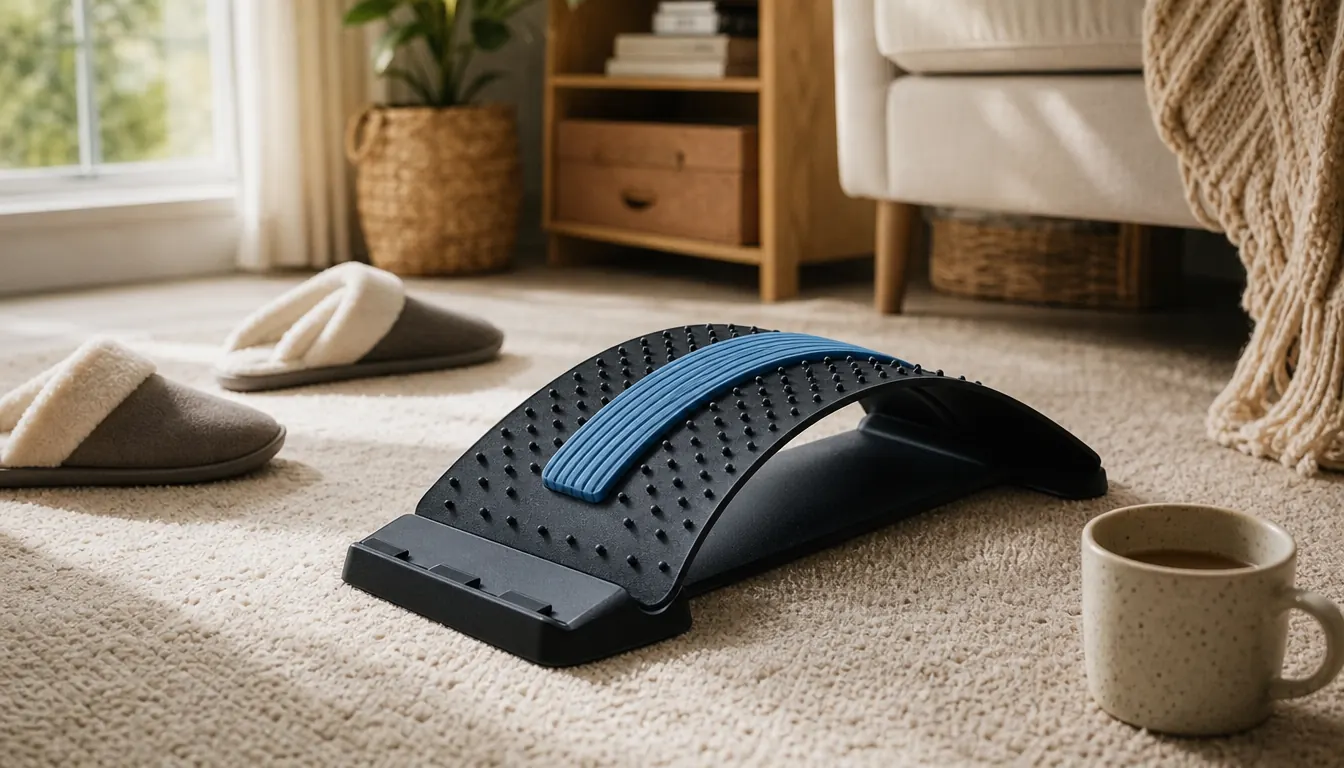
Two different jobs, and I want to say that up front so nobody wastes a season on the wrong one. I bought the MINOLL back stretcher in early October, about five weeks ago, and it sits on the living room carpet now like it has always been there. A fellow in my Thursday foursome keeps the Everlasting Comfort lumbar board strapped to the seat of his truck, and I have looked at it plenty of times while we were loading our bags after a round. People lump the two together because they both turn up under back pain relief. They are not the same tool. One is a stretch you lie down for. The other is a cushion that holds your lower back in a curve while you sit.
Short answer. If your back is stiff when you get out of bed and worse the morning after a round, and you want five minutes of work you can do on the floor at night, the MINOLL is the one I own and the one I would buy again. If your back aches from sitting, at a desk, in a truck, in a chair at the clubhouse, the Everlasting Comfort board addresses a problem the MINOLL does not touch. I have never owned the Everlasting Comfort. Everything I say about it comes from the listing, the published specs, and watching a friend use his. I am 67, I walk three rounds a week near Maryville, Tennessee, and my doctor told me my lower back is ordinary wear and muscle tightness, not a disc. That is the back I am writing about.
| MINOLL Back Stretcher | Everlasting Comfort Lumbar Board | |
|---|---|---|
| What it does | Lies flat on the floor and arches your spine over an adjustable curve | Straps to a chair back and holds your lower back in a supported curve while you sit |
| Adjustability | Multiple arch levels, listed as height adjustable | One fixed contour, adjusted by strap tension rather than shape |
| Time per session | The listing suggests 5 to 10 minutes, twice a day, on the floor | As long as you are sitting, with nothing extra to schedule |
| All-day use | Nothing once you stand up | Works the entire time you are seated |
| Where you use it | Carpet or rug, living room or locker room floor | Any chair it will strap to, including a truck seat |
| Portability | About 2 pounds, listed at 5.71 by 3.87 by 0.62 inches, goes in the car | Lives on one chair and moves when you move the chair |
| Build | ABS plastic with an EVA top surface, per the listing | Memory foam with a strap |
| Best for | Stiffness that needs a stretch you have to make time for | Aching that comes from being parked in one position |
| Where it falls short | You have to get down on the floor and back up again | Does nothing for you the moment you stand |
Where the MINOLL Wins
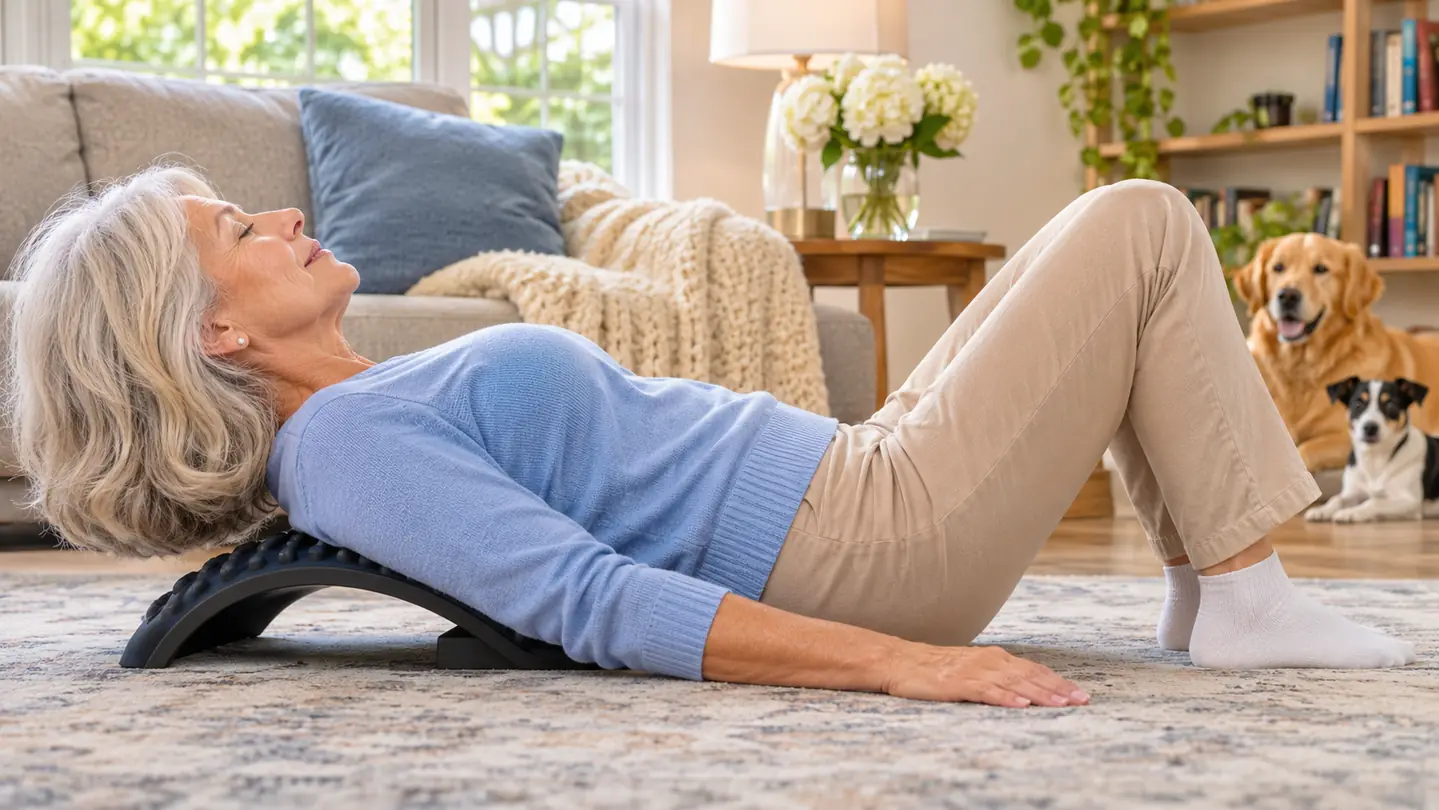
Adjustability is the big one, and it is the reason I ended up with this thing instead of something simpler. The MINOLL has multiple arch levels, and the listing calls it height adjustable. That sounds like a small feature until you use it. My first week I was on the lowest setting and it still felt like a lot by the third minute. Five weeks in I am on the middle setting, and three to five minutes does what a rolled towel and twenty minutes on the carpet used to do. A single fixed contour gives you one height. You either fit it or you do not, and if you do not, you are stuck. My physical therapist gave me a floor routine about three years ago, lying on my back with my knees bent, and the arch does the same kind of work with more curve and a lot less guessing about whether I have my hips where they belong.
Portability is the second thing. It is about 2 pounds and the listing gives the folded footprint as 5.71 by 3.87 by 0.62 inches, so it stows small. Mine lives on the carpet, but it drops into the back of the 2019 CR-V next to the folded Caddytek cart without me thinking about it, and I have carried it into the club twice to use before a round. A chair cushion does not travel like that. It is strapped to a chair, and there it stays until you unstrap it. If you want one piece of gear that goes from the living room to the car to a hotel room on a golf trip, the stretcher is the one that moves. The board is the one that waits for you to come back to the chair.
Where the Everlasting Comfort Board Wins
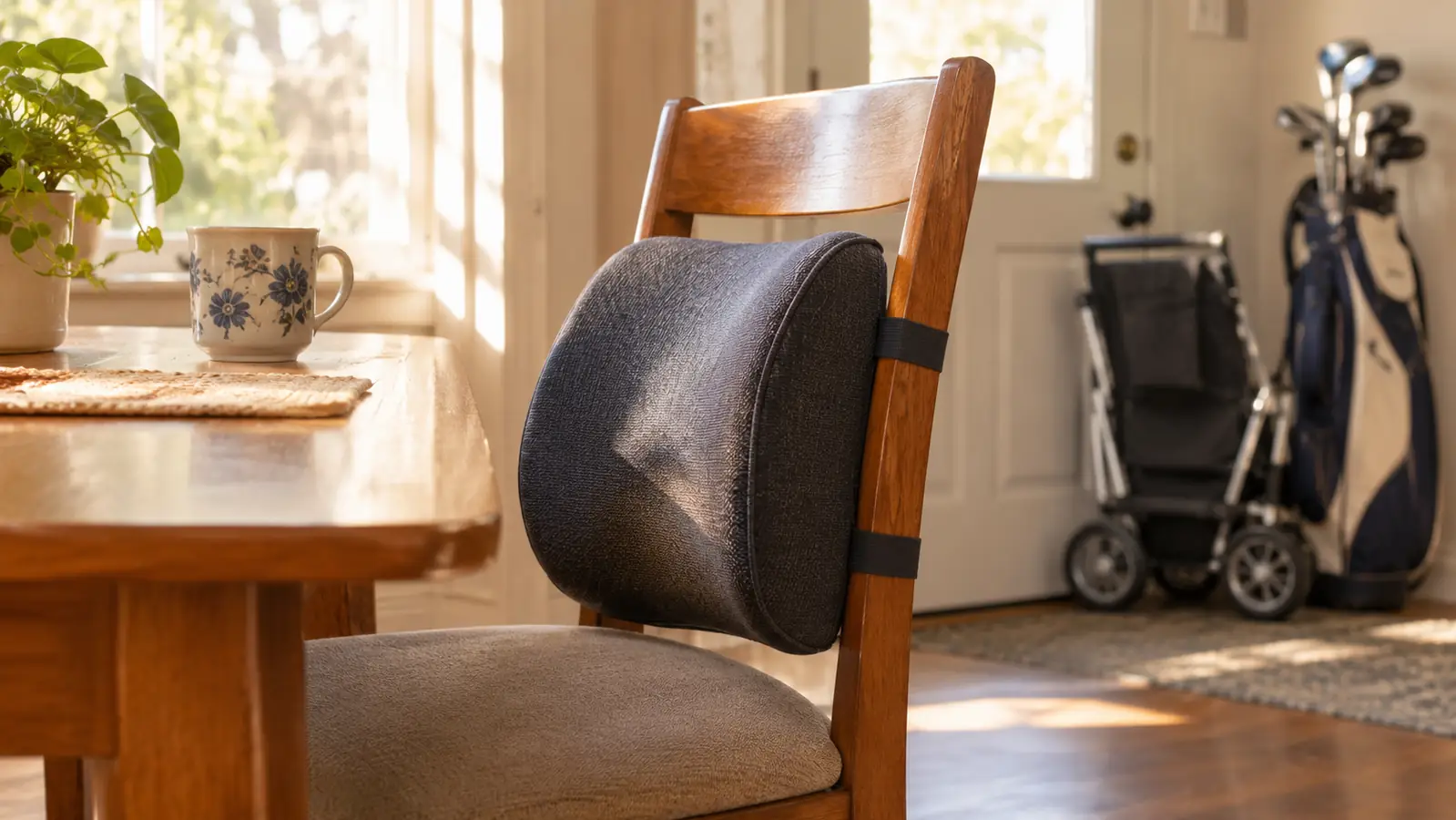
Sitting. Plain and simple, and I am not going to pretend otherwise. The Everlasting Comfort is a memory foam lumbar cushion with a strap, and its entire job is to hold your lower back in a supported curve while you are seated. That is the exact thing the MINOLL cannot do. You do not lie back on a stretcher at a desk. You do not lean into one in a truck. My friend has his strapped to the driver's seat and says it is the difference between a two hour drive being fine and a two hour drive being a chore. I believe him, because the problem he is solving is not the problem I have. Mine shows up after a round and first thing in the morning. His shows up when he has been parked in one spot too long.
The board also asks nothing of you. No getting down, no getting up, no five minute window you have to protect from the dogs and the phone. That reads like a small thing until you are 67 and the floor is further away than it used to be. The MINOLL requires a decision every time. The board just sits there and does its work while you do something else, whether that is driving to the course or eating lunch or reading. If your back is at its worst after an hour in one position, the board fits the shape of your day better than a floor device ever will, and no amount of arch levels changes that.
The Five Minute Version, For The Back That Stiffens Up Rather Than Aches
The MINOLL back stretcher has multiple arch levels so you can start low and work up, weighs about 2 pounds, and fits in the back of the car next to the cart. It is the floor work, not the chair work. If that is the half of the problem you have, start here.
Amazon Check Today's Price on Amazon →How Five Weeks With the MINOLL Actually Went
I bought it in early October, so this is five weeks of honest use, not five days. Week one I was on the lowest arch setting for two minutes at a time and it was not comfortable. Not painful, but my lower back let me know it was there. That is normal for a stretch you have not been doing, and my physical therapist's floor routine felt the same way back when I started it. Week two I got to four minutes on the low setting. By week four I moved to the middle setting, and that is where I have stayed. Three to five minutes, most evenings, on the living room carpet with the dogs wandering past.
The pattern that surprised me is when it helps most. Sunday evening and the evening after a round are the two slots that matter. My back is worst the morning after I walk eighteen, and the stretch the night before seems to take the edge off that morning. That is my experience, not a medical claim, and I would not tell anyone it will work the same way for them. The other thing it replaced is the rolled towel and the knees-bent lying on the floor that I had been doing for three years. Same idea, more curve, and I do not have to fight to hold a position.
What it does not do is equally worth saying. It does not fix how I sit. When I am in the recliner with the heating pad on for twenty minutes after a cold round, that is a different tool doing a different job, and the board my friend uses would probably help that half of my day more than the stretcher does. It also does not replace the core work my doctor told me to keep up. I still do the routine. The stretcher is one piece of it, not the whole thing, and anybody selling you a single board as the whole thing is overselling.
The build has held up fine. ABS plastic with an EVA top surface, per the listing, and after five weeks of daily use it looks the same as the day it came out of the box. The listing shows 4.2 stars across about 4,800 reviews, which is roughly what I would give it. Not perfect, because the first week on the low setting is a real adjustment and because you have to get on the floor to use it at all. But it does what it says, and it does it in five minutes, which is about all the patience I have for floor work at the end of a day.
Five weeks in, three to five minutes on the middle arch does what a rolled towel and twenty minutes on the carpet used to do.
What I Liked
- Multiple arch levels, so you can start low and work up instead of forcing one fixed height
- About 2 pounds and small enough to ride in the back of the car next to the push cart
- Short sessions, three to five minutes once you are used to it
- Simple to set: pick a level, lie back, breathe
Where It Falls Short
- You have to get down on the floor and back up again, and at 67 that is the real obstacle
- The first week on the lowest setting is not comfortable
- Does nothing for the hours you spend sitting
- No guidance beyond the listing's suggestion of 5 to 10 minutes twice a day, so you have to pace yourself
Where I'd Slow Down Before Buying Either
The floor is the honest objection to the MINOLL and I will not dress it up. Getting down onto the carpet is fine. Getting up is the part that takes planning, especially the day after a long walk. If you have a knee that complains or you live alone and the coffee table is the nearest thing to grab, think about that before you buy a device that only works at floor level. Nobody in a review column tells you that part. I am telling you, because it is the thing that decides whether you use it or whether it leans against the wall.
For the board, the objection is the mirror image. It does not come off the chair, so if you do not spend much of your day seated, it has nothing to do. A golfer who walks three rounds a week and is on his feet the rest of the time is not the customer for a lumbar cushion. It also has one contour, and a chair is a chair. If your seat is shaped differently or the strap will not sit flat, you will feel it. And with either one, if the pain is sharp, or it runs down a leg, or it does not settle in a couple of weeks, that is a doctor conversation, not a shopping decision. Mine was ordinary wear and muscle tightness. Yours may not be, and no product on this page can tell you which.
Who Should Buy Which
Buy the MINOLL if your back stiffens rather than aches, if the worst of it is the first ten minutes of the morning and the day after a round, if you already have a floor routine from a physical therapist and want something that does the same work with less fiddling, and if you will actually get down on the carpet for five minutes. At 67 with a 14 handicap and three walks a week, that describes me, and I would buy it again tomorrow.
Buy the Everlasting Comfort board if your back complains from sitting. Desk work, long drives, a chair at the clubhouse, a recliner. That is a support problem and support is what a lumbar cushion does. And if you are the sort of person who has both problems, sitting all week and walking all weekend, then you are looking at two tools and not a choice between them. I know which half I would buy first for my back, and it is the one that sits on my carpet. My friend in the foursome would say the opposite, and we would both be right about our own backs. If you are not sure which one you are, ask your doctor before you spend anything.
Start On The Lowest Arch And Work Up From There
That is what I did, and five weeks later I am on the middle level for three to five minutes an evening. Multiple arch levels, about 2 pounds, and it stows in the car next to the cart.
Amazon Check Today's Price on Amazon →