
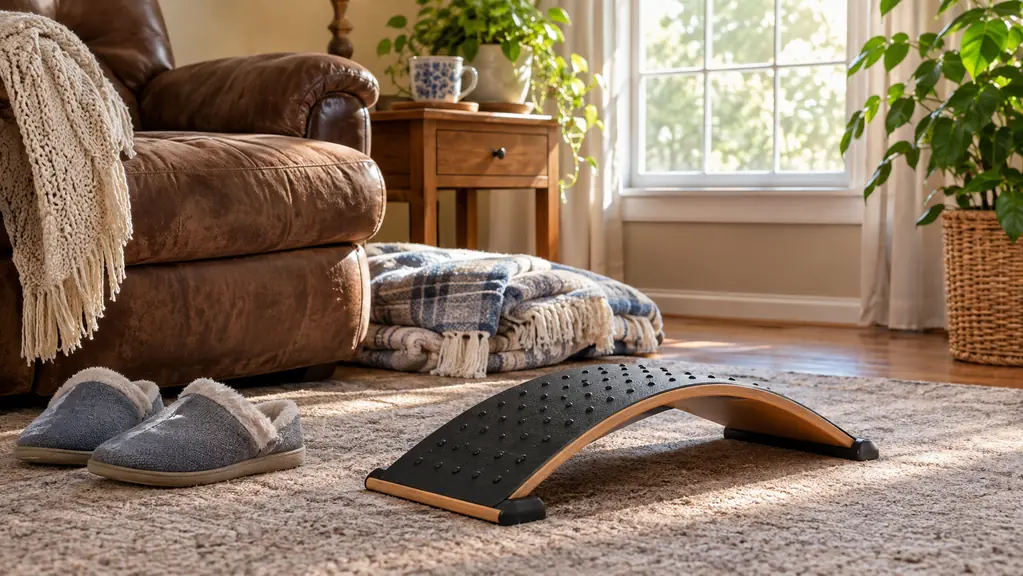
Eighteen holes on a Thursday, and by seven that evening I was on the living room floor with my knees bent, working through the same four stretches my physical therapist handed me three years ago. That routine kept me walking the course three rounds a week, but I skipped it more often than I did it. A man will skip anything that feels like homework. So in early October 2026 I bought a MINOLL back stretcher with my own money. It is an arched board you lie back over, the listing calls it a back cracker and a spine decompression board, and I have used it almost every evening for about five weeks now. Here is what a month of that looks like for a 67-year-old retired airline mechanic in Maryville, Tennessee, with a stiff lower back that my doctor calls ordinary wear and muscle tightness, not a disc problem.
Before anything else: I am not a doctor, not a physical therapist, and not a golf pro. My back has been looked at. If yours has not, or if the pain is sharp, runs down a leg, comes with numbness, or does not settle after a couple of weeks, go get it checked before you buy a board off the internet. What follows is one man and one piece of equipment. Nothing more than that.
The Quick Verdict
Does one job and does it well. Five minutes a night, an arch you raise as your back allows, and the morning after a round stopped being my worst hour of the week. The first week is genuinely uncomfortable, and it does nothing for the rest of your spine.
Amazon Check Today's Price →Five weeks in, it has earned the spot beside my recliner
The MINOLL back stretcher is the last thing I do before bed now. Same board, same five minutes, sitting on the floor where I cannot walk past it and forget.
Amazon Check Today's Price on Amazon →How I've Used It
I bought it in early October 2026. Two days later the box was on the porch, and it weighed less than the bag of dog food I carried in behind it. Inside was the board and a folded sheet of paper with a few line drawings. The drawing that mattered showed where the arch goes against your back, and it sits lower than I expected, down near the belt line rather than up between the shoulder blades. I had figured it would land higher, up in the middle of the back. It does not.
I read that sheet twice. Thirty-four years turning wrenches on commercial airplanes taught me that the man who skips the manual is the man who rounds off a bolt, and I figure my own spine deserves at least that much respect. The sheet says five to ten minutes, twice a day. I will tell you what I actually do, which is not that.
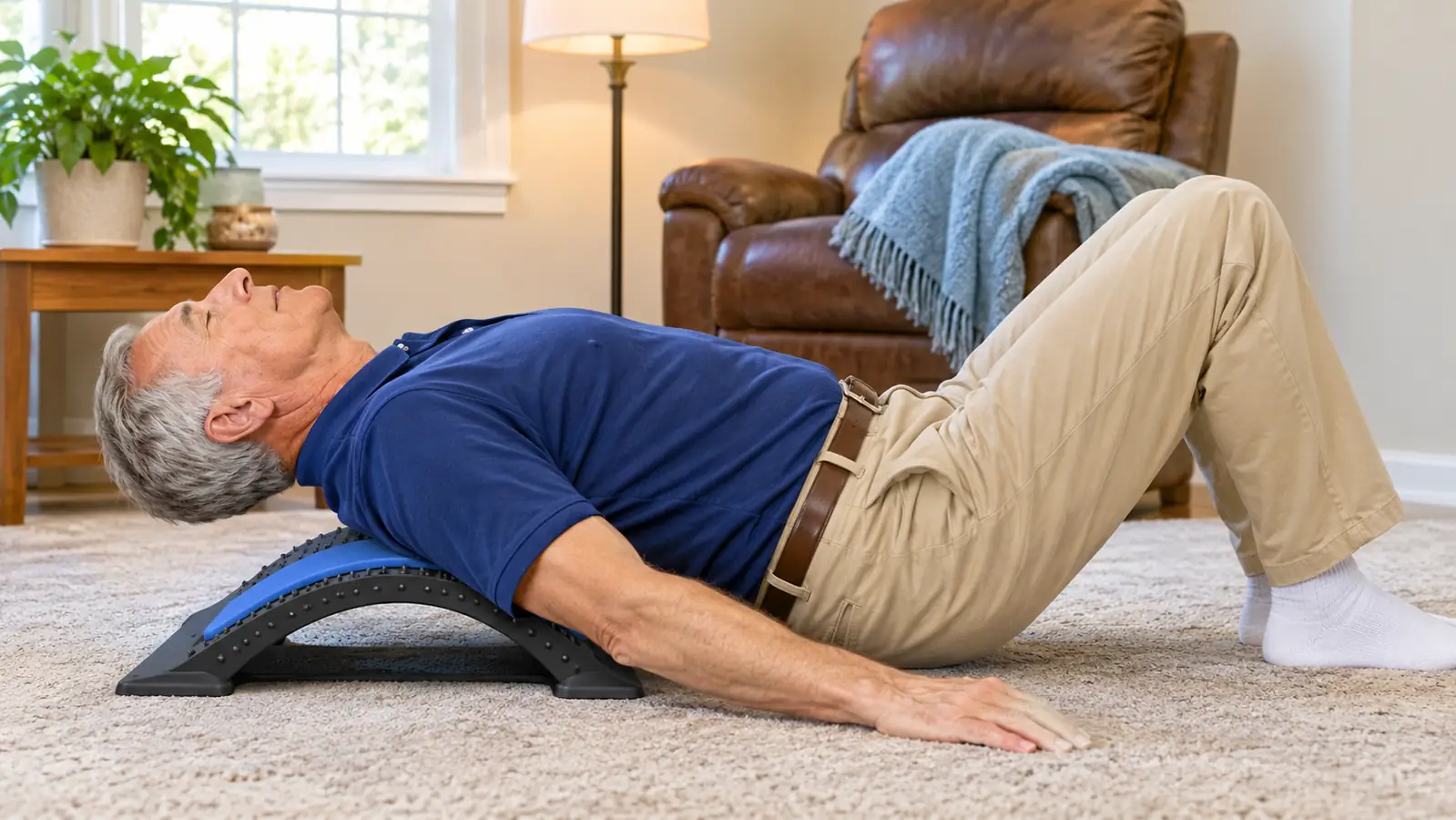
The first week I set the arch on the lowest of the settings and lay back for three minutes. Not five. Three. My back had opinions about three. I did it on the living room carpet beside my recliner, with a rolled towel under my head, because that carpet is thin and my head is not. The first night I also made the mistake of leaving my belt on. Take the belt off. That is free advice and it is worth what you paid for it.
By the second week I was up to four minutes. By the end of October I had moved to the middle setting and that is where I have stayed. Five minutes, sometimes six, most evenings, always after a round and often on the days between. The one evening I skipped was a Saturday when Carol had her sister over and the living room was full of people and folding chairs. I felt it the next morning more than I expected to, which told me the five minutes were doing something.
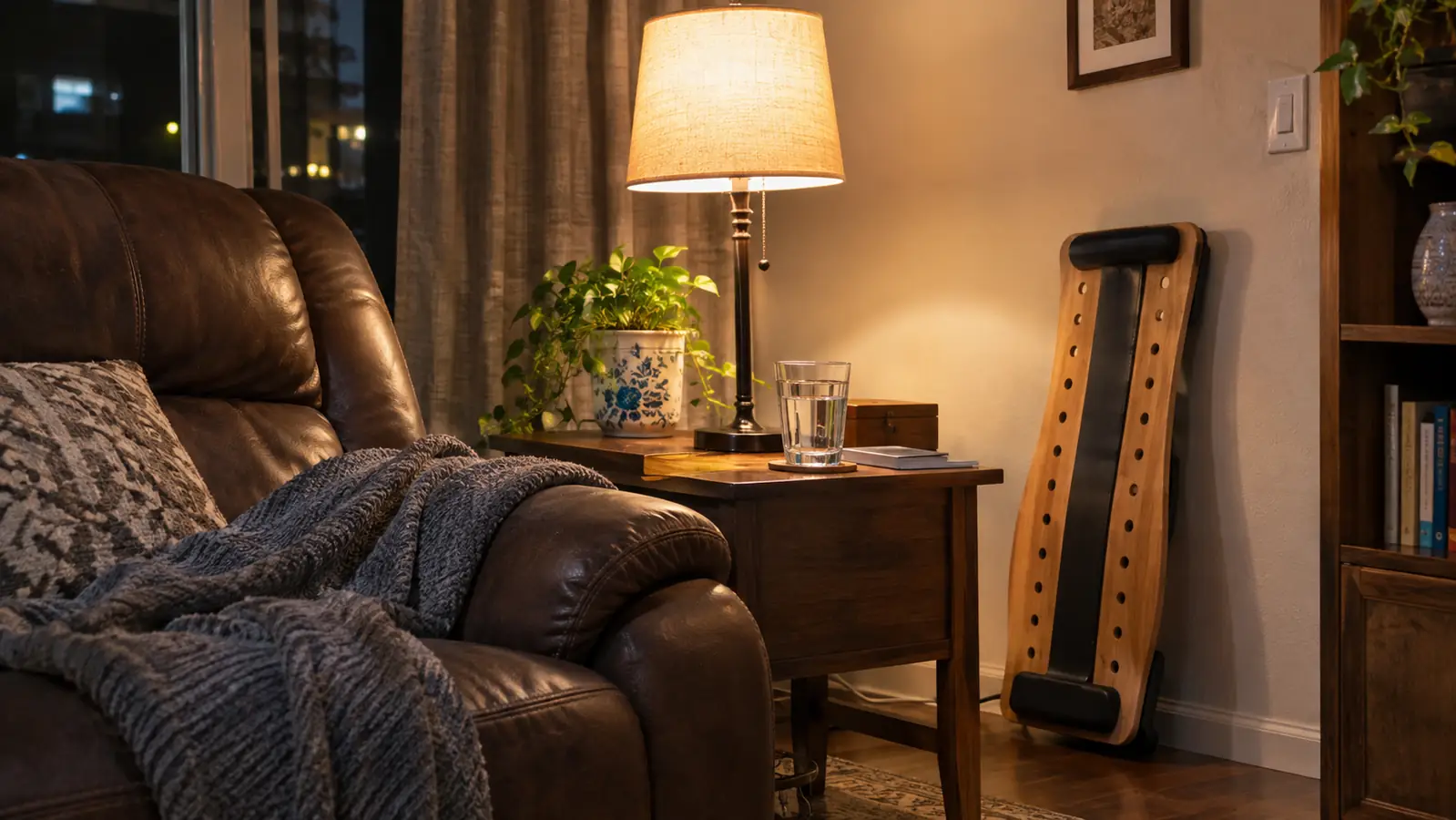
I keep the board leaning against the wall beside the recliner, and that is most of the reason the habit stuck. It weighs about two pounds, so moving it is nothing. The two days it lived in the hall closet were two days I did not use it. Do not put yours in a closet.
One more thing about timing. Mine happens between the evening news and bed, somewhere around nine, and I am usually off the floor by ten past. Early on I tried it at six, right after supper, and that was worse. Everything is tighter then. Whatever your nine o'clock is, put the board there and leave it there.
What the Adjustable Arch Actually Does
The board gives your lower back a fixed curve to lie over. That is the whole mechanism. You are not pulling on anything and you are not hanging from anything. You lie down, the arch pushes up, and your lower back extends over it. The adjustable part is the height of that curve, which controls how much extension you get in one go. Nothing about it is complicated and nothing about it is clever. It is a shape, and you put your back over the shape.
On the lowest setting it is a firm nudge. On the middle setting it is a real stretch, and I can feel it in the exact spot my physical therapist used to find with her thumb, just off the spine on the left side. There is a setting above the middle. I have not gone there and I may not. When I reasoned it out loud at the kitchen table, Carol said I sounded like a man working up to hurting himself, and she was probably right. The board has no opinion about when you have had enough, so you have to bring your own judgment down to the floor with you.
The thing it does that lying flat never did for me is extend rather than relax. Knees bent on the carpet, which was my old routine, mostly lets the back go slack. The arch puts it into a position I cannot reach on my own. I tested that on myself during the first week, four minutes flat on the floor with no board and then four minutes over the board, ten minutes apart. They are not the same thing, and it is not close. The listing says the design increases the back contact area so the pressure spreads instead of digging into one spot, and having lain on it I believe that part. It is not a narrow rail under one vertebra.
The material list is ABS and EVA, one hard plastic and one foam, and that is about what it feels like in use: a firm shell with a foam layer bonded to the top. I would not call it padded and I would not want it to be, because a cushion soft enough to be comfortable would swallow most of the stretch. There is just enough give that five minutes does not leave marks across your back. Firm is the point.
What Changed After a Round
I walk all three of my rounds, push cart since April 2025, and my handicap sits around 14. Two times of day used to be reliably bad. The first tee on a cold morning, and the morning after a round, when I would swing my legs out of bed like a hinge that needed oil. Carol will tell you I was not pleasant company before about nine o'clock on a Friday.
The first tee did not fix itself. What changed is that I now use the board the night before a round, and that stiff stretch which used to run a solid hour has come down to something closer to twenty minutes. The morning after is the bigger difference. I still feel it. I just do not have to walk it off before I can stand up straight and reach for the coffee. On the Tuesday after a wet, cold round in late October, I was on my feet and out the door with the dogs at the usual time, and in September that would not have happened.
The back nine is where I notice the second-order effect. When my lower back is not guarding, I turn through the ball instead of steering it, and I get less of that tired ache over the last four holes. That is not a swing fix and I am not selling one. It is what happens when the part that was complaining stops complaining quite so loud.
The First Two Weeks Were Not Comfortable
I want to be straight about this, because the reviews I read before I bought mine were split and now I know why. The board is firm. It is not a cushion and it is not trying to be. The first four or five times, three minutes felt like plenty, and I had a dull soreness the next morning that made me wonder whether I had done something stupid.
So I backed off. Three minutes, lowest setting, every other night, until that stopped leaving a mark. It took about ten days. Had I started at the middle setting for ten minutes because the listing said so, I would have quit and written a one-star review, and I would have been wrong about the board and right about my own impatience. Those ten days of backing off were the most useful part of the whole experiment, because they taught me the board is not something you push through.
The soreness in week one was not the sharp kind and it did not run down my leg, and I called my doctor's office about it anyway, because that is what you do at my age. They said what you would expect. Back off, keep moving, call if it changes character. It went away on its own once I stopped trying to be tough about it. If yours is sharp, or runs down a leg, or comes with numbness, that is a different conversation and it does not happen on a floor mat with a board on it.
The other thing nobody mentions is the floor itself. At 67, getting down and back up is its own event, especially the evening after eighteen holes walking. I put the board where the carpet is, next to the recliner, so I have something to hold on the way up. If your knees are worse than mine, do it beside a couch.
How It Fits With Everything Else I Use
My evening has a sequence now, and the MINOLL board is the last step in it. Cart folded into the back of the CR-V, dogs walked, shoes off at the door, then the recliner. Biscuit and Tank get their walk either way. The order is what makes it work, because by the time I sit down the day is finished and there is nothing left to talk myself out of.
In the recliner I use the electric heating pad I bought in December 2025, medium setting, twenty to thirty minutes on the lower back while I watch something. That loosens things up. Then I get on the floor with the board for five minutes. Doing the board cold is a different and worse experience than doing it after the pad. That order was not in any instructions. I figured it out by trying it the other way exactly once.
The brace I bought in March 2026 still goes on the course on cold mornings, over a thin base layer and loosened between shots when I get warm. The warm-up stick I bought in August 2026 gets five minutes of slow swings in the parking lot before the first tee. None of those replaced each other. The brace gets me through a round, the stick gets me loose before one, and the pad and the board are what I do afterward. Biscuit and Tank do not care about any of it, though they do supervise from the rug.
What It Doesn't Do
It does not cure anything. My doctor told me to stay active, warm up and keep my core strong, and he meant all three. The board is five minutes of extension at the end of the day. It is not a substitute for the core work and it is not a substitute for the warm-up.
It also does not always crack. The MINOLL listing calls it a back cracker, and sometimes you get a pop that feels like a knuckle going back into place. Sometimes you get nothing but a stretch. If you are buying it purely for the pop, you will be disappointed on roughly half the evenings.
And it works on the lower back. That is the target and that is all. My mid back and my shoulders get nothing out of it. If your trouble lives up between the shoulder blades, this is the wrong tool and no amount of patience will change that.
What I Liked
- Adjustable arch lets you start at the lowest setting and move up when your back allows
- Five minutes is short enough that I have actually kept the habit for five straight weeks
- Firm enough to extend the lower back rather than let it go slack
- About two pounds, so it leans against the wall beside the recliner and stays in sight
- Broad contact area spreads the pressure instead of digging into one spot
Where It Falls Short
- The first week is genuinely uncomfortable and there is no way around it
- Firm surface with no real padding
- Getting down to the floor and back up is half the job at 67
- Nothing on the board tells you when you have had enough
- Does nothing for the mid back or the shoulders
Three minutes on the lowest setting was all my back would take in October. Five weeks later I am at the middle setting for five, and the morning after a round is twenty minutes of stiffness instead of an hour.
Who This Is For
This suits a golfer or a walker whose lower back has been looked at and called ordinary wear and tightness, who already has a warm-up and a stretching routine, and who wants one more thing at the end of the day that takes five minutes and does not require a gym membership or a drive. It suits someone patient enough to spend ten days on the lowest setting before touching anything higher. If you walk your rounds and the morning after is your worst hour, this is aimed squarely at you. The MINOLL board is not fancy and it does not need to be.
Who Should Skip It
Skip it if your pain is sharp, runs down a leg, comes with numbness or weakness, or has not been checked by a doctor. Skip it if you will not get down on the floor, or if your knees make that a bad idea. Skip it if you want a device that improves your swing, because this never touches your swing. And skip it if you are after a pop every single time, because you will get one maybe half the evenings and a plain stretch the rest of them.
Same board, same five minutes, five weeks running
If the morning after a round is your worst hour, this is the simplest experiment in my whole evening routine. Start at the lowest setting and give it ten days before you decide anything.
Amazon Check Today's Price on Amazon →