

Twelve years I carried my stand bag on my right shoulder. For the last six of those years my lower back started to tighten around the 12th tee, and by the time I reached the car it had turned into a dull ache that followed me home and sat with me through dinner. Nothing sharp. Nothing that shot down a leg. Just a stiff, tired, used-up feeling that made the last six holes a chore and made Tuesday morning a negotiation with my own socks. I am 67, I live twenty minutes south of Knoxville, and I play three rounds a week at a public course near Maryville, walking every one of them. The walking was never the problem. The twenty-five pounds of clubs hanging off one shoulder for four hours was.
In April 2025 I bought a Caddytek CaddyLite 11.5 V3 push cart. I have pushed it for two full seasons now, three rounds a week, better than 200 rounds total. I am not going to tell you a cart fixed my back, because it did not, and no cart will. What it did was take the single dumbest thing I was doing to myself three times a week and remove it. What follows is the routine I built around that Caddytek cart: five steps, run in this order, every round. None of them are complicated. Together they are the difference between walking 18 holes and limping through the last four.
Step one is getting the bag off your shoulder. This is the cart I did it with.
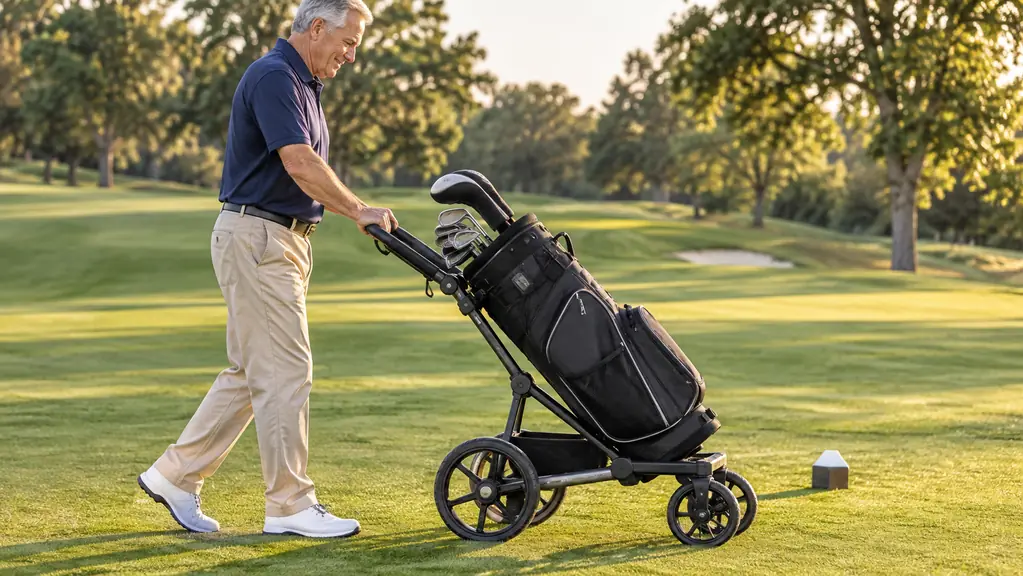
The Caddytek CaddyLite 11.5 V3 has been under my hands for two seasons and better than 200 rounds of walking. Aluminum frame, 13.8 pounds, three wheels, a foot brake I can work without bending over, and it folds into the back of my CR-V. 4,286 ratings average 4.5 at the time I am writing this.
Amazon Check Today's Price on Amazon →Step 1: Get the cart out of the car without a twist
This sounds like it isn't a step. It is, and it's the one I got wrong first. The worst thing I did in my first month with the cart was pull it out of the back of the CR-V one-handed with a twist. The cart weighs 13.8 pounds. That isn't heavy in any normal sense. It is heavy enough, held at arm's length, with a rotation, on a 45 degree morning when nothing on me is warm yet. I felt it in the parking lot before I ever reached the first tee.
The quad-fold frame folds down small enough that I can get one hand around it. I grab it with both hands now, keep it close to my body, and set it on the ground before I unfold anything. Then I unfold it, set the brake, and only after that do I lift my bag off the ground and set it on the cart. Two separate lifts, both square to my body, neither one with a twist. It costs me ten extra seconds in the morning and it's the difference between starting a round loose and starting it guarded.
I also load the bag on the cart in the parking lot, not on the first tee. Standing in the grass holding a bag at an angle while I work it onto a cart is exactly the position my lower back hates, and the parking lot is flat and I can take my time. By the time I walk to the tee, the cart is loaded and the only thing I'm carrying is a couple of tees and a ball in my pocket.
Step 2: Set the handle height once and leave it alone
The handle adjusts and for the first two weeks I moved it constantly. Up for the driver, down for putting, which is nonsense, because I'm not pushing the cart while I swing. I finally set it at a height where my arms hang almost straight and my hands land on the handle without me leaning forward, and I have not touched it since the spring of 2025.
That one setting matters more than it sounds. Too low and you walk hunched over the cart for four hours, and your lower back does the work your arms should be doing. Too high and your shoulders creep up around your ears and you end up gripping the handle like a shopping cart with a bad wheel. The right height for me is the one where my elbows stay slightly bent and I can push with the heel of my hand instead of my fingers.
Then check how the bag sits before you walk away. My stand bag rides with the heavy end, the woods and the ball pocket, toward the handle, and it sits centered. A cart loaded off-center pulls to one side, and you spend the whole round correcting it with one wrist and one shoulder, which works its way down into your back by the turn. I noticed the pull before I noticed the cause, and it took me a full round to figure out the bag was the problem and not the cart.
Step 3: Five minutes of warm-up before you touch the handle
My physical therapist gave me a routine about three years ago: gentle extension, hip rotations, and a set of slow half swings. I did it about half the time, which is another way of saying I skipped it on cold mornings, which is exactly when I needed it most. Now it's every round, in the parking lot, before I walk to the first tee. Five minutes. That's the whole commitment.
I swing a warm-up stick, slow, maybe twenty swings at half speed, and I finish with five swings at about 70 percent. It isn't a workout. It's a check-in. If something catches on the third swing, I want to know that in the parking lot with a car nearby, not on the 14th fairway with a creek in front of the ball and three guys waiting on the tee behind me.
The part people skip is the transition. A warm-up that ends with you standing still for ten minutes waiting on the group ahead is a warm-up you wasted. I time mine so that I finish the last swing, load the bag, and walk to the tee without stopping. Ten years of standing around after stretching taught me that much.
Two full seasons, three rounds a week, and I have not once finished 18 and thought about the drive home instead of the round.

Step 4: Push with both hands and use the brake every time
There is a technique to pushing a cart for four hours, and it has nothing to do with strength. Both hands on the handle, arms fairly straight, walking behind it at my normal stride. The moment I start pulling the cart along beside me with one hand, I have turned a two-arm job into a one-arm job, and my lower back pays the difference by the 15th hole. I catch myself doing it when I'm in a hurry and I make myself stop and take the handle with both hands.
The foot brake gets used more than people expect. Any time I stop on a slope, I set it. Any time I walk away from the cart to hit a shot, I set it. Chasing a cart that has started rolling downhill is how a stiff back becomes a tweaked back, and it's a foot pedal, so I don't have to bend over to work it. That last part matters more than it sounds like it should when your back is already talking to you.
The rest of it is course management. I walk the long way around a green if the short way is up a slope. I keep the cart on the path on the holes where the fairway is soft and the wheels would dig in. The 11.5 inch rear wheels and the 10.5 inch front wheel roll over tree roots and curbs better than the smaller wheels on the cart one of my Thursday group pushes, and that matters when you're steering with your hands and not with your hips. And on the 10th tee I take my hands off the handle, stand up straight, and give it ten seconds. That's it. That's the whole trick.
Step 5: The twenty minutes after the round decide tomorrow morning
I unload the bag first and the cart second. The bag is the awkward lift, so I want that done while I'm still fresh and not after I've already bent over twice to fold things up. Then I fold the cart, put it in the back of the CR-V, and drive home. The loading and unloading takes about three minutes total, and I do it the same way every time so I don't have to think about it on a day when my back is tired.
At home I don't sit down right away. I walk the dogs, Biscuit and Tank, about a half mile, which is the best thing I do for my back all day. Then I stretch on the living room floor. If the round was long or cold, I lie on my back with my knees bent for three to five minutes, and lately I've been using a back stretcher on the middle arch setting, after starting at the lowest one and working up over a few weeks.
In the winter, or after any round where the temperature never got out of the 40s, I sit in the recliner with a heating pad on my lower back, medium setting, 20 to 30 minutes, with the auto shut-off left on. I don't sleep on it. That's a rule I made for myself in December and haven't broken.
What Else Helps
Two other things earn their place in the routine. On cold mornings, and on the round after a day when my back is already sore, I wear a lumbar brace snugged over a thin base layer. I asked my doctor before I started wearing it, and he said a brace was fine as support while I keep up the core work. I loosen it between shots when I get warm, and I don't wear it every round.
The other one is boring and it does more than the equipment. My doctor told me to stay active and strengthen my core, so I do about ten minutes of core work four mornings a week on the floor in the living room while the coffee is going. Dead bugs, bird dogs, and a plank I hold badly. Three years in, that does more for my back nine than anything I've bought, the cart included.
The swing side of it went to the pro at our club, not to me. He looked at my setup, moved my ball position an inch, and told me to stop trying to hit the ball with my lower back. That was two seasons ago and it's still the best advice I've had. And the standard warning applies here: if your pain is sharp, if it runs down a leg, or if it doesn't settle in a week or two, this routine is not the answer for you. See your doctor.
Two seasons on this cart. If it rolled into the garage tonight I'd order another one tomorrow.
Aluminum frame, 13.8 pounds, three wheels, an adjustable handle you set once, and a foot brake you can work without bending over. It folds into the back of a CR-V with your bag beside it, and it carries a one-year limited warranty. If you are walking with a stiff back and still carrying, start here and build the rest of the routine around it.
Amazon Check Today's Price on Amazon →