
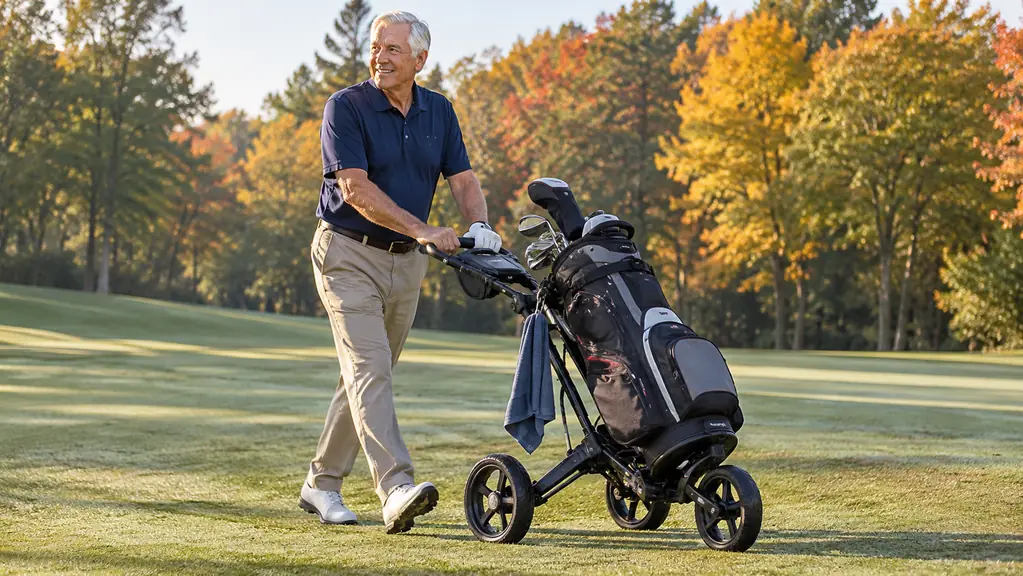
For twelve years I carried my stand bag on my right shoulder. Around sixty, my lower back started letting me know about it. The first tee was never the problem. The back nine was, and the morning after was worse. In April 2025 I bought a Caddytek CaddyLite 11.5 V3, mostly because a fella in my Thursday foursome would not stop talking about his. Two full seasons later, roughly 150 rounds, it is the change I would make again first.
Let me be clear about what I am and am not. I am a retired commercial airline mechanic, 67 years old, living south of Knoxville. I am not a doctor, not a physical therapist, and not the pro at our club. My doctor told me my lower back trouble is ordinary wear and muscle tightness, not a disc problem, and to stay active, warm up, and keep up the core work my physical therapist gave me three years ago. If your pain is sharp, runs down a leg, or does not settle, that is a conversation for your doctor, not for a golf cart article. What follows is what I noticed about the load on my shoulder, not a treatment plan.
The cart that took the bag off my shoulder for good
Two seasons, three rounds a week, one shoulder that finally got a break. This is the Caddytek CaddyLite 11.5 V3 I actually walk with.
Amazon Check Today's Price on Amazon →Your bag rides on three wheels instead of one shoulder
This is the whole reason I am writing this. A stand bag on one shoulder is a one-sided load, and I was carrying it for four hours, three times a week, for twelve years. On the Caddytek the bag sits on the frame. Both hands go on the handle and the weight runs down through three wheels into the ground. My back is not holding anything up and it is not twisted to the left for the back nine. That was the first difference I noticed, and it is the one that has held up over two full seasons.
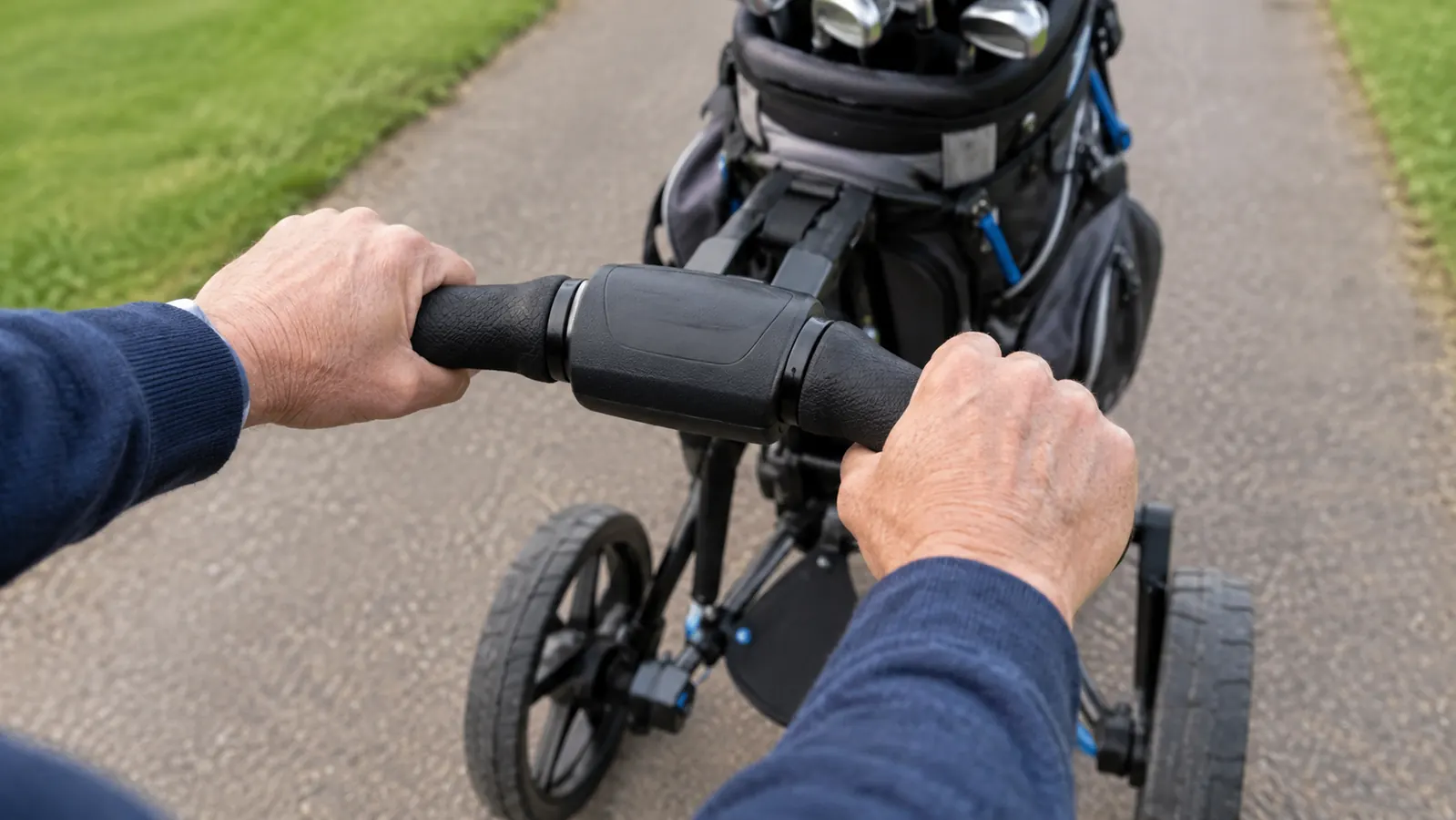
The handle adjusts so you quit stooping over a low bar
The TPR handle slides up and down, which means you can set it where your hands fall naturally instead of bending to meet a fixed bar. I set mine the first week and have not touched it since. It takes a second to change, which matters if two people share the cart. The point is that you push standing up straight rather than walking hunched for four miles. I noticed that in my neck and shoulders before I noticed it anywhere else, and I noticed it on the very first round.
A foot brake means one less bend, forty times a round
The brake is foot-activated. You step on it at the tee box and the cart stays where you left it. You step on it again and you are rolling. No bending down to set a hand brake, no chasing the cart when the ground tilts toward the pond. On its own it sounds like nothing at all. Multiply it by every tee box and every green across eighteen holes and it is exactly the kind of small bend that adds up on a stiff Saturday morning.
It folds down and disappears into the back of the car
The frame has a quad-fold design, so it collapses into a compact bundle. Mine lives in the back of my 2019 Honda CR-V next to my bag and I do not think about it from one round to the next. In the old days the bag went onto my shoulder in the driveway and stayed there. Now it goes into the car, comes out rolling, and goes back the same way. Fewer lifts, and the lifts I do make are with two hands and a straight back instead of a shoulder hike.
13.8 pounds, so lifting it stays a one-hand job
The cart weighs 13.8 pounds. In and out of the trunk twice a round is four lifts, every round, three rounds a week. A lighter aluminum frame means I pick it up with one hand and set it down without a twist through my middle. It also means I am not grunting it up onto the tailgate at the end of a round when I am already tired. I am 67. I would rather spend my effort on the swing than on the trunk.
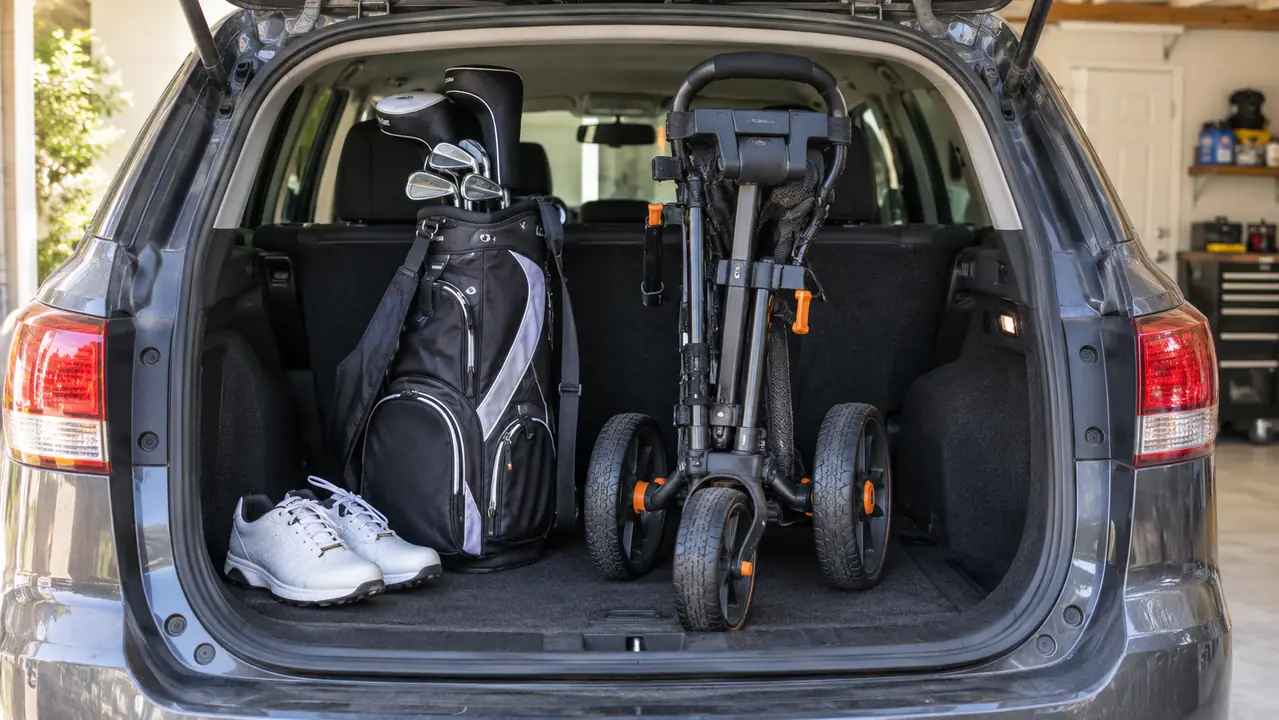
Bigger wheels roll over the junk instead of catching
Dual 11.5 inch rear wheels, a 10.5 inch front wheel, and EVA tires. What that buys you is a cart that rolls over roots, cart path seams and patchy rough instead of stopping dead and yanking the handle out of your grip. Every one of those yanks used to travel up my arms and into my shoulders. Now the cart just bumps along. It also tracks straight, so I am not fighting it left and right for eighteen holes with a sore back.
The mesh net and magnetic pad keep you out of the bag
There is a mesh net under the frame and a magnetic pad up on the console. Balls, a towel, my glove, and the small junk I used to dig out of the bag pocket six times a round now rides where I can reach it while standing up. The magnetic pad catches the scorecard. Fewer trips into the bag means fewer bends, and fewer bends is the entire point of this list. I moved my whole pocket routine onto the cart in the first month.
Umbrella and drink holders get the extra weight off your hands
The cart comes with an umbrella holder and mount plus a drink holder. That means the umbrella rides on the frame instead of living in one hand while you push with the other, and the water bottle is not swinging off a shoulder strap all afternoon. Pushing with two hands square on the handle is a straight, even push. Pushing with a bottle in one hand and one hand on the bar is not, and I did that for years without thinking about it.
Two seasons in, nothing has rattled loose
Aluminum frame on the Caddytek, a one-year limited warranty against manufacturing defects, and mine has done roughly 150 rounds with the bag strapped on the whole time. Nothing has loosened, nothing squeaks, and the folding joint still locks up tight. I am a retired airline mechanic, which means I notice hardware whether I want to or not. I have tightened one bolt in two seasons and it was on the umbrella mount. It also carries 4,286 ratings at 4.5 stars, so I am not the only one who has had this experience.
It makes three rounds a week realistic instead of ambitious
Here is what actually changed. I walk three rounds a week at 67. Before the cart I walked two and paid for the third one on Sunday and again on Monday morning. Not because a push cart heals anything, because it does not. Because taking a one-sided load off my shoulder for four hours meant my back had less to recover from between rounds. My doctor's advice was to stay active. The cart is the reason I stay active instead of sitting out Thursdays.
What I'd Skip
If you are hoping a cart fixes a bad back, skip it. It takes the bag off your shoulder. It does not strengthen your core, and the routine my physical therapist handed me three years ago is still the part that matters most. Skip pushing with one hand. That puts the load back on one side, which is the exact thing you are trying to get away from. Skip the notion that you need a motorized anything if you walk a flat course, because a 13.8 pound cart with three wheels is plenty of help. Skip carrying a half set to save weight, since a half set in a stand bag is still hanging off your shoulder. And skip all of this advice, mine included, if your pain is sharp, runs down a leg, or has not settled in a week or two. Go see your doctor.
The cart did not fix my back. It stopped me from loading one shoulder for four hours, three times a week, and that was the part I could actually control.
Two seasons of walking, and the bag never touched my shoulder
If your back is the reason you are reading a list about push carts, start here. The Caddytek CaddyLite 11.5 V3 folds, rolls, and carries the bag so you do not have to.
Amazon Check Today's Price on Amazon →