

My lower back is at its worst in exactly two places. Standing on the first tee with a club in my hand, and swinging my legs out of bed the morning after a round. It has been that way since around the time I turned 60. My doctor looked at it, told me it was ordinary wear and muscle tightness rather than a disc problem, and told me to stay active, warm up properly and keep my core strong. My physical therapist gave me a stretching routine about three years ago and I still do it most mornings. None of that is a cure. It is maintenance, and maintenance is the reason I am still walking three rounds a week at 67 instead of riding a cart and feeling sorry for myself.
What I added in early October, about five weeks ago, is a back stretcher. Specifically the MINOLL back stretcher, the adjustable arch board with multiple height levels. I bought it myself on Amazon after reading through several hundred of the 4,821 reviews on the listing. I started on the lowest arch setting, moved to the middle one after a couple of weeks, and I use it three to five minutes at a time on the living room carpet. Below is the routine in the order I actually do it, plus the things around it that matter just as much as the board does.
The Five-Minute Stop Between the Car and the Recliner
This is the adjustable arch board I bought in October 2026 and use on the living room carpet after every round. Height adjustable, about two pounds, small enough to live beside the sofa instead of in the garage. Multiple levels means you can start low and earn your way up.
Amazon Check Today's Price on Amazon →Step 1: Walk Ten Minutes Before You Sit Down
This is the step people skip, and it is the one my physical therapist hammered into me years ago. When I finish a round I do not drive home and drop straight into the recliner. I walk. At the course it is a slow lap of the parking lot while I unstrap the bag from the Caddytek cart and fold it down. At home it is Biscuit and Tank, our two dogs, around the block. Biscuit is a seven-year-old golden and Tank is a four-year-old Boston terrier, and neither one of them walks fast, which is exactly the point. Ten easy minutes gets blood moving through muscles that have spent three hours tightening up.
If I skip the walk and sit down, I can feel the lower back set into a knot by the time the evening news is over. Then the stretcher has to fight through a cold, locked-up back instead of a warm one. Walk first. Stretch second. Sit down third. That order is not a preference, it is the whole thing.
Step 2: Set the Arch Level While You Are Still Standing
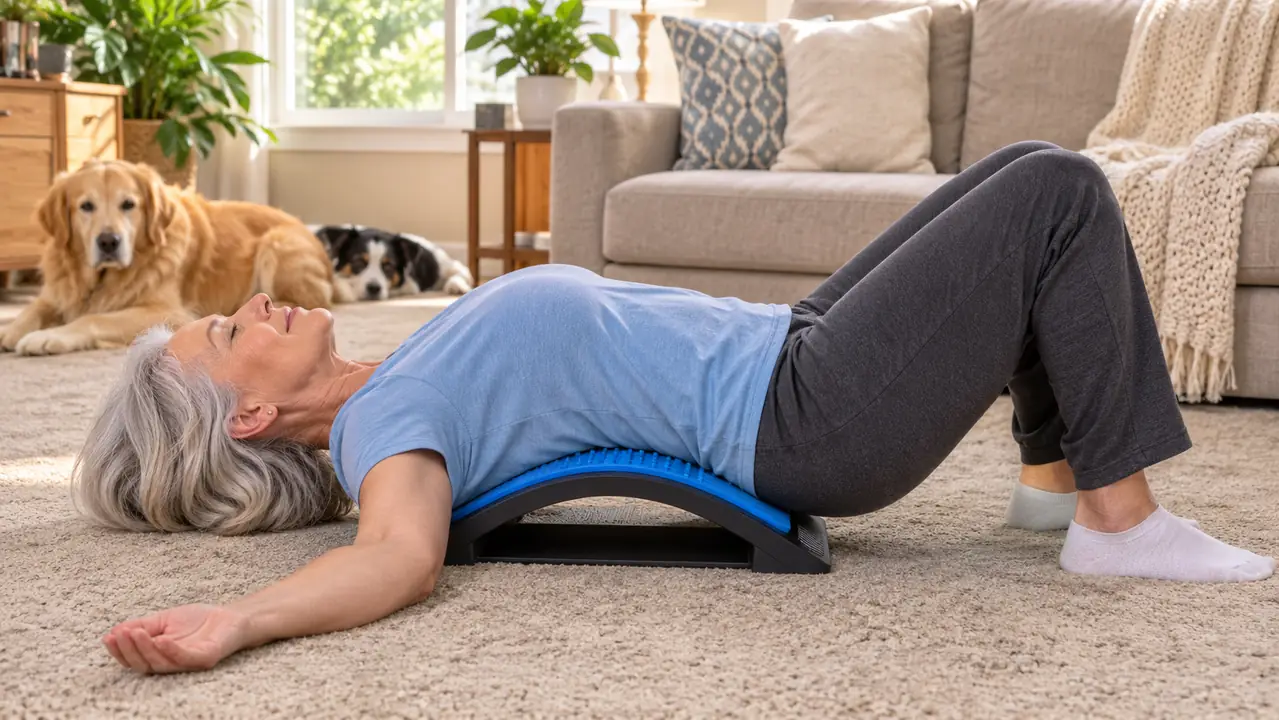
The MINOLL board has multiple levels of arch height and the adjustment is the reason it works for me. Set the level while you are still standing and the board is still in your hands. If you wait until you are on the floor, you will either lie there on a setting that is wrong for you or you will get up, change it, and get back down, which is a good way to talk yourself out of the whole routine by Thursday.
A word on why I started low. My first afternoon with it I was feeling good after a decent round and put it on a taller arch. Five minutes later my lower back was sore in a way that had nothing to do with golf, and I was annoyed at myself. I went back to the bottom setting for two solid weeks, then moved up one level at a time. The board itself is light, about two pounds by the listing, and it lives on the floor beside the sofa. That matters more than it sounds. A piece of equipment that has to be fetched from a shelf in the garage does not get used in November.
Step 3: Sit Down First, Then Lower Yourself Back
Sit on the carpet with your knees bent and your feet flat. Set the board behind you so the arch lands under your lower back, roughly at the belt line. Then lower yourself back onto it with your hands taking some of the weight. Not up under the shoulder blades, not down on the tailbone. Head rests on the floor. Arms out to the sides a little so you are not fighting to balance. Nobody should be dropping onto this thing from a standing position, and I say that as a man who has tried to hurry a lot of things.
The padding is EVA foam over an ABS frame, so it is firm with a little give rather than soft. If getting down to the floor and back up is a genuine problem for you, this is not the tool and I would not pretend otherwise. Talk to your doctor or your physical therapist about what fits your situation. For me the floor is fine. I just do not scoot around while I am lying on it.

Step 4: Set a Timer and Get Up Before You Get Sore
The listing suggests five to ten minutes each time, twice a day. I started shorter than that on purpose. My first week was two to three minutes, once a day, in the evening. Five weeks in, I am at five minutes after a round and five minutes the following morning on days I play. That is well inside what the listing recommends, and I got there by adding time slowly rather than by being ambitious on day one.
The timer matters because lying there feels good and the temptation is to stay for twenty minutes. I did that once. My back was stiff in a completely different way the next morning, the kind of stiff that comes from overstaying, and I have used the phone timer ever since. When it goes off, roll to your side, push up with your arms, and stand up slowly. Breathing the whole time. If you are holding your breath and bracing, you are doing it wrong and you will know it.
Step 5: Do It the Morning After, Not Just the Same Evening
The evening session is the pleasant one. The morning after is the one that actually changed my week. For years the day after a round was worse than the round itself, and I had accepted that as the price of playing three times a week. Now I walk the dogs, come in, and do five minutes on the middle arch before I sit down for breakfast. Then the therapist's stretches: knees to chest, the figure four, the hip one I cannot pronounce. The board loosens things up and the stretches keep them loose. Neither one does much on its own for me.
The other half of this is what I do not do. On the morning of a round I leave the board alone. Five minutes of stretching right before I go play makes me feel loose in a way that does not last, and I would rather warm up on my feet. That is what the swing trainer in the parking lot is for. Save the board for after.
Five weeks in: three minutes on the lowest arch became five minutes on the middle one, and the morning after a round stopped being the worst part of my week.
What Else Helps
The board is one piece of a routine, not the routine itself. The biggest single change to my lower back came in April 2025 when I stopped carrying a stand bag on one shoulder for twelve years and started pushing the Caddytek CaddyLite. My back used to be worst on the back nine. Now it is worst on the first tee, which tells you something about which one was a fatigue problem. If you are still carrying your bag at 67, that is the first thing I would change, before you spend anything on recovery gear.
Second is the Deepsoon electric heating pad I bought in December 2025. Twenty to thirty minutes on the medium setting in the recliner, lower back only, auto shut-off left on. That got me through last winter and it still comes out after a cold round. Third is the MUELLER lumbar brace, bought in March 2026 for the cold mornings and the round after a sore day. I asked my doctor about it first and he said a brace was fine as support while I keep up the core work, which is the part I want to be clear about. It is support, not a substitute for the exercises.
Fourth is the Balight swing trainer I picked up in August 2026. Five minutes of slow swings and turns in the parking lot before the first tee, and some evenings on the back patio. That is a warm-up tool. Swing changes themselves go to the pro at our club, not to me and not to a piece of plastic on the living room floor. And the unglamorous fifth thing is the walking. Biscuit and Tank get me out the door most mornings whether I feel like it or not.
What It Won't Do
It will not fix a disc, and it will not replace the stretching routine or the core work. It will not correct your swing, and if your lower back hurts because of how you move through the ball, a board on the floor is not going to change that. What it does for me is buy five minutes of relief after a round and take the edge off the following morning. I am not going to tell you it fixed anything, because it did not. It is a tool I use several times a week and would buy again.
The honest downsides. The arch takes getting used to and the first week is not comfortable. The levels require some trial and error before you find the one that suits you, and the wrong level will leave you sore. The 4.2-star average on 4,821 reviews tells you it works well for most people and not for everyone, which is about what I would expect from a hard piece of equipment you lie on. And if your pain is sharp, radiates down a leg, or does not settle after a few days of rest, put the board down and go see your doctor. That is not a disclaimer, that is what I would tell you in person.
Start on the Lowest Arch and Give It Two Weeks
The MINOLL back stretcher is the board I have used after every round since early October 2026. Height adjustable, about two pounds, and it fits on the floor beside the sofa where you will actually see it. Start low, set a timer, and stop before you feel sore.
Amazon Check Today's Price on Amazon →