

I measured the back of my 2019 Honda CR-V with a tape measure before I ordered the Caddytek CaddyLite 11.5 V3. That is the part of push cart shopping that almost never makes it into a review. Every write up talks about how a cart rolls across a fairway. Very few tell you whether the folded thing will sit behind the seat without a wrestling match at six in the morning.
I am 67. I retired after 34 years as a commercial airline mechanic, and I spent most of those years around folding gear that either stows clean or turns into a fight with your hands. So the cart got measured before it got trusted. Two full seasons later, three rounds a week, always walking, here is what I know. The good is real. The tradeoffs are real. And a couple of things I read online before I bought it turned out to be wrong. I bought the cart myself, and nobody from Caddytek has ever spoken to me.
The Quick Verdict
Folds into a bundle small enough for a small SUV and rolls straight with a loaded stand bag on it. The foot brake takes a deliberate stomp, and the umbrella holder is the weakest piece in the box.
Amazon Check Today's Price →The cart that fits behind the second row
Two seasons of walking, one folded bundle in the back of a CR-V, and a stand bag that stays strapped on. Check the current listing details and today's price on Amazon.
Amazon Check Today's Price on Amazon →How I've Used It: Three Rounds a Week for Two Seasons
I play three rounds a week at a public course near Maryville, Tennessee, and I have walked every one of them since April 2025. Before the Caddytek I carried a stand bag on one shoulder for twelve years. My lower back is stiff and achy, worst on the first tee and the morning after a round. My doctor told me it is ordinary wear and muscle tightness rather than a disc problem, and told me to stay active and keep up the core work my physical therapist gave me. Trading the shoulder strap for a cart is the single biggest change I have made.
The first assembly took me about ten minutes, mostly because I read the manual, which is a habit I brought home from the airlines. The stand bag straps to the frame with two straps and does not shift. Between rounds the bag stays on the cart in the garage, folded, so Thursday morning is open the hatch, lift, go, and I am done in under a minute.
I should be straight about one thing before I go further. I have never owned another push cart, so every comparison I make here comes from looking at listings, from what the fellas in my Thursday foursome use, and from what I have picked up and put down in the pro shop. I am not going to pretend I ran a test I did not run.
What Nobody Tells You About the Fold
The folded package measures 35 by 11 by 11 inches according to the listing. That is a long, narrow bundle, about the size of a loaded duffel bag. In the CR-V it lies flat behind the second row with the stand bag on top of it, and there is still room for groceries on the way home. Here is the part nobody mentions. The length is the number that matters. This is not a cube, and if your trunk is short and deep rather than long, measure it before you order. I would have been unhappy to learn that in the driveway.
The quad fold frame is what produces that shape. The two rear wheels fold up against the frame, the front wheel tucks in behind the bag, and the handle drops down over the top. After two seasons I can do it in about eight seconds with one hand on the frame and one on the release. The first month it took me closer to twenty, and I pinched a finger twice learning where not to put it.
One warning about folding. There is a mesh net across the lower frame, and if you leave a sleeve of balls in it while you fold the cart, they end up on the garage floor. That happened in my first week. Now the net gets emptied first, and it has held its shape through two seasons of that treatment.
The Weight Number, Honestly
The listing gives 13.8 pounds in the item details and 13.75 in the product bullet. A man who spent 34 years reading maintenance documents notices that sort of mismatch. My garage scale says 13.8, so that is the number I go with. It is light for anything with three wheels and a frame. It is not weightless.
At 67, with a back that complains, the lift into the CR-V is the moment of the day my back notices the cart. Not the pushing. The lift. It is one clean motion with bent knees and a hand near the axle end. It is a bad idea when I try to swing it in with straight arms. None of that is a failing of the Caddytek design, it is how I pick things up, but an honest review has to say it out loud rather than pretend the cart is a feather.
What the weight buys you is a cart you can push with one hand on level ground. My stand bag, fully loaded with clubs, balls, a rain jacket and a bottle, does not fight the frame. If you have been carrying your bag, that difference is not a small one. It is the whole reason I bought the thing.
Rolling, and What the Wheels Do on Wet Grass
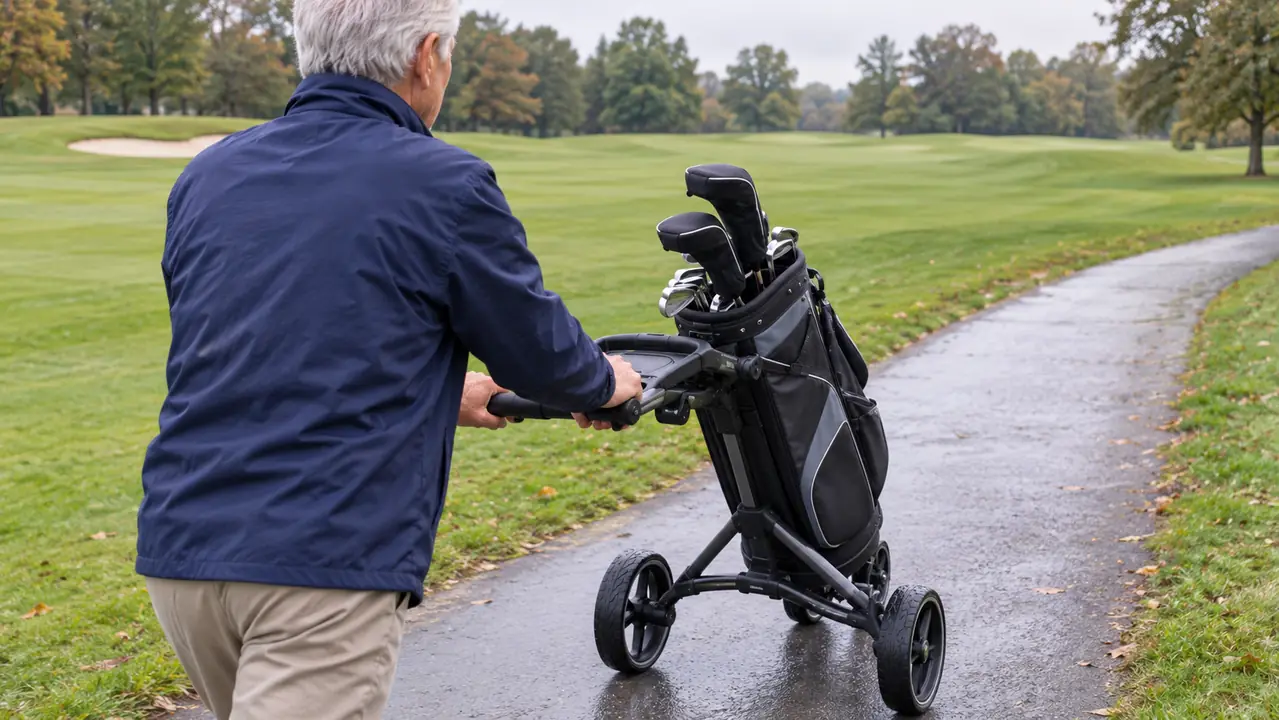
The cart runs dual 11.5 inch rear wheels and a 10.5 inch front wheel with EVA tires, which means no inner tubes and no pump living in my garage. On dry fairway it tracks straight and quiet. The front wheel pivots easily, so turning onto a path does not require lifting the front end, and lifting the front end is exactly the motion that used to catch my back when the bag was on my shoulder.
Wet morning grass is where I expected trouble and where I got less than I feared. On a damp fairway in October the cart rolls heavier, the way any cart will, but it does not slide sideways. My course has one long hill on the back nine that I used to dread. With the bag on the cart I lean into the handle and walk it up. On the way down I keep a hand on the frame and let the brake do its job at the bottom.
The one place the wheels have surprised me is wet leaves on a paved path in November. The cart will drift half a wheel width and correct itself. It has never gone over on me, and I have not had to chase it down a slope. For a man walking three rounds a week on a public course in east Tennessee, that is about all I can ask of a wheel.
The Handle, the Brake, and the Small Parts
The handle is TPR with an adjustable height. I found my setting in the first week and have not touched it since. There is adjustment left in either direction, so a taller golfer than me has room, and a shorter one does too. There is no give in the handle under load, which was not true of a cart I borrowed once from the pro shop.
The brake is foot activated. You press down on the pedal at the rear wheels and the cart locks. It works. It also demands a firm, deliberate stomp, and on a slope you want to look back and confirm it took. Twice in two seasons I have thought it was set when it was not, and both times the cart rolled a few feet on me. The fix is to press it all the way down and never trust a half press. If balance is an issue for you, practice this on flat ground before you take it to a hill.
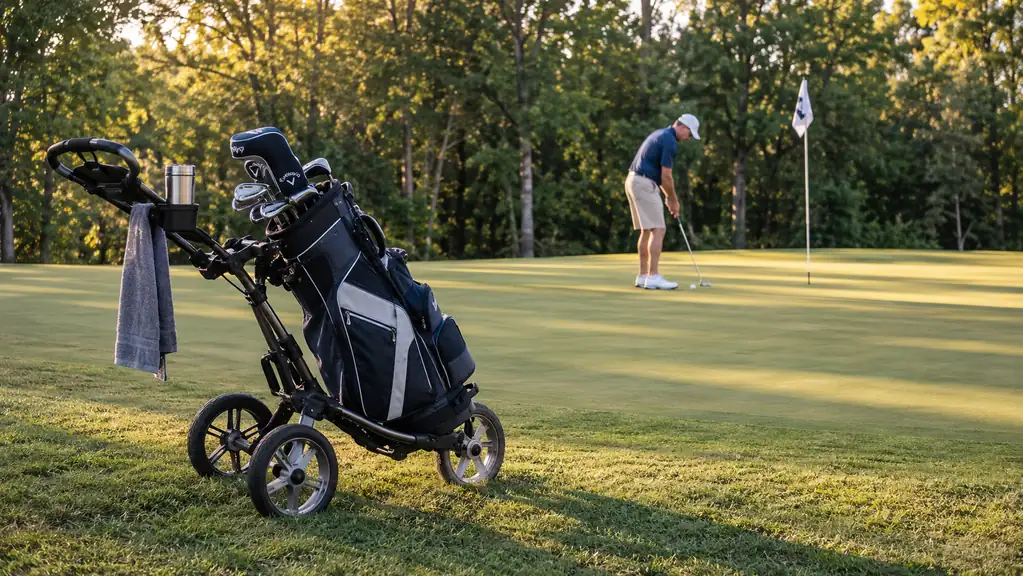
The small parts are a mesh net for storage, a magnetic pad, an umbrella holder with its mount, and a drink holder. The magnetic pad is the one I use most, for the scorecard and a spare ball. The drink holder is shallow, and a wide insulated bottle will lean. The umbrella holder clamps to the frame and does the job in a light rain, though it is the piece I trust least, and if a gust gets under the canopy the whole cart wants to lean with it. I take the umbrella down when it starts blowing.
Somewhere north of 200 rounds on the same set of EVA wheels, with a loaded stand bag strapped on, and the cart still tracks straight.
Where It Falls Short
The foot brake is my main complaint. A hand brake up on the handle would suit a golfer with a stiff back better, because stopping to bend and stomp means stopping the walk, and stopping the walk is what stiffens me up in the first place. This cart does not have one. I do not think that is a defect. I think it is a design tradeoff on a cart built to a weight and a fold. It is still the thing I would change.
The umbrella holder is second. It holds, but the mount flexes under a real wind and the canopy pulls the cart around with it. For a drizzle it is fine and I have used it that way. For a Tennessee spring squall I carry the umbrella myself and leave the holder empty.
Third, the drink holder is sized for a standard can or bottle and not much else. I have taken to hanging a bottle from the mesh net instead. And the warranty is one year limited, which is ordinary for this kind of gear but worth knowing if you walk as much as I do and plan on getting several seasons out of it.
What I Liked
- Folds into a 35 by 11 by 11 inch bundle that lies flat behind the second row of a small SUV
- 13.8 pounds, and pushable one handed on level ground with a loaded stand bag
- Dual 11.5 inch rear wheels and a 10.5 inch front hold a line on damp grass
- Umbrella holder, drink holder, mesh net and magnetic pad all come in the box
Where It Falls Short
- Foot brake only, and it needs a full deliberate stomp to set
- Umbrella mount flexes in a real wind
- Drink holder is shallow for a wide bottle
- One year limited warranty
Care and What Wore First
I rinse the EVA wheels with a hose every few weeks and wipe the aluminum frame down with a rag. No air pressure, no tubes, nothing to pump. Before every round I press the brake once and watch it hold, which costs me a second and saved me a rolled cart the two times I skipped it.
After roughly 200 rounds the wear is honest. Scuffs on the frame from the hatch of the car. The mesh net has stretched a little but has not torn. The tires show tread wear but no chunking. The folding release is as tight as the day I unboxed it. The only part I would call tired is the umbrella holder, and I have already told you how I feel about that.
How It Compares to What My Foursome Pushes
I have never owned another cart, so this section is secondhand and I will label it that way. One fella in the Thursday group pushes a cart with a hand brake lever up on the handle. I have watched him stop on a slope with two fingers and I have envied it, especially on that hill on the back nine. Another one pushes a cart with a wider stance that he swears feels steadier when it is loaded down, and it also takes up more room in a trunk than mine does.
In the pro shop I have picked up the store carts and folded them. Most of them fold into something closer to a cube, which stows easier in a deep trunk and worse in a shallow one. None of them struck me as badly built. I bought the Caddytek because of the folded length, the 13.8 pounds, and EVA wheels that do not need air. If your trunk is deep and short rather than long, that calculation could come out differently for you, and it should.
Who This Is For
This cart suits a golfer who walks, who already has a stand bag, and who wants the whole rig to disappear into the back of a small SUV between rounds. It suits somebody whose back complains after eighteen holes of carrying and who is not ready to move to an electric cart. It suits a tinkerer, because the fold rewards a person who takes ten minutes in the driveway to learn it instead of fighting it on the first tee.
Who Should Skip It
Skip it if you need a hand brake on the handle, if you play in wind and rain and want an umbrella mount you can lean on, or if your trunk is short and deep, because 35 inches is 35 inches no matter how you turn it. Skip it if you want a cart with a cooler built in, since this one has a drink holder and a mesh net and nothing more. And if your back pain is sharp, or runs down a leg, or does not settle after a couple of days, that is a conversation for your doctor and not a shopping decision. A cart can take a strap off your shoulder. It cannot fix what is underneath.
What I'd Tell You in the Parking Lot
Learn the fold on flat ground at home before you take it to the course. Empty the mesh net first. Set the handle height once and leave it alone. Press the brake like you mean it, and glance back at the cart before you walk away. Do those four things and the Caddytek CaddyLite will do what mine has done for two seasons, which is sit in the back of the car, roll straight, and take the strap off my shoulder on Thursday morning.
If the folded length fits your trunk, the rest of this cart holds up
Two seasons, three rounds a week, one set of EVA wheels, and the same frame I unboxed in April 2025. See the full listing and today's price on Amazon, and measure your trunk first.
Amazon Check Today's Price on Amazon →