

Eight months is long enough to know what a thing is and what it is not. I bought the MUELLER lumbar back brace in March 2026, right at the start of the season, and I have worn it on and off ever since. I am 67 years old. I play three rounds a week at a public course south of Knoxville and I walk all three of them. My lower back has been stiff and achy since about age 60, worst on the first tee and the morning after a round. My doctor looked at it, called it ordinary wear and muscle tightness, ruled out a disc problem, and told me to stay active, warm up, and strengthen my core.
So I did not buy a brace expecting it to repair anything. I bought it because March and April mornings in east Tennessee are cold, and standing on the first tee with a stiff lower back while the rest of the foursome is already swinging is a poor way to start a round. I asked my doctor before I ordered it. He said a brace was fine as support while I kept up the core work. That is the whole premise of this review. It is support, not repair. Here is the short version, and then I will tell you the parts I wish somebody had told me before I clicked buy.
The Quick Verdict
Real support from four steel springs and an adjustable closure, and an honest piece of gear that knows what it is. It is a cold morning tool, not a year round fix, and it is only as good as the size you order.
Amazon Check Today's Price →The brace that lives in my bag from November to April
Four steel springs, a removable pad, and a closure you can back off a notch between shots. It supports a stiff lower back on a cold morning. It does not pretend to fix one.
Amazon Check Today's Price on Amazon →How I Actually Used It
I want to be specific about that, because saying I wore a back brace could mean almost anything. My rule was simple. Cold morning, the brace goes on. Morning after a sore day, the brace goes on. Everything else, it stays in the bag. Over eight months that works out to maybe thirty-five or forty rounds out of the hundred or so I played. That is the honest number, and I think it tells you more about this product than any five star review you will read.
The fit matters more than anything else I am going to tell you here. I wear it over a thin base layer, a moisture wicking shirt, not over a polo and definitely not against bare skin. Snug enough that I feel it holding when I set up to the ball. Not so snug that I am thinking about it on the backswing. When I get warm, usually around the fifth or sixth hole, I reach under my shirt and back the closure off a notch with one hand. It takes about four seconds and I do not have to take anything off to do it.
The first round with it I was sure the whole foursome would notice. Nobody noticed. It goes under a shirt, and a polo hanging loose covers it completely. The only comment I got all season was from the pro at our club, who asked if I had hurt myself, and that was because I was moving carefully on a cold morning, not because of anything I was wearing.
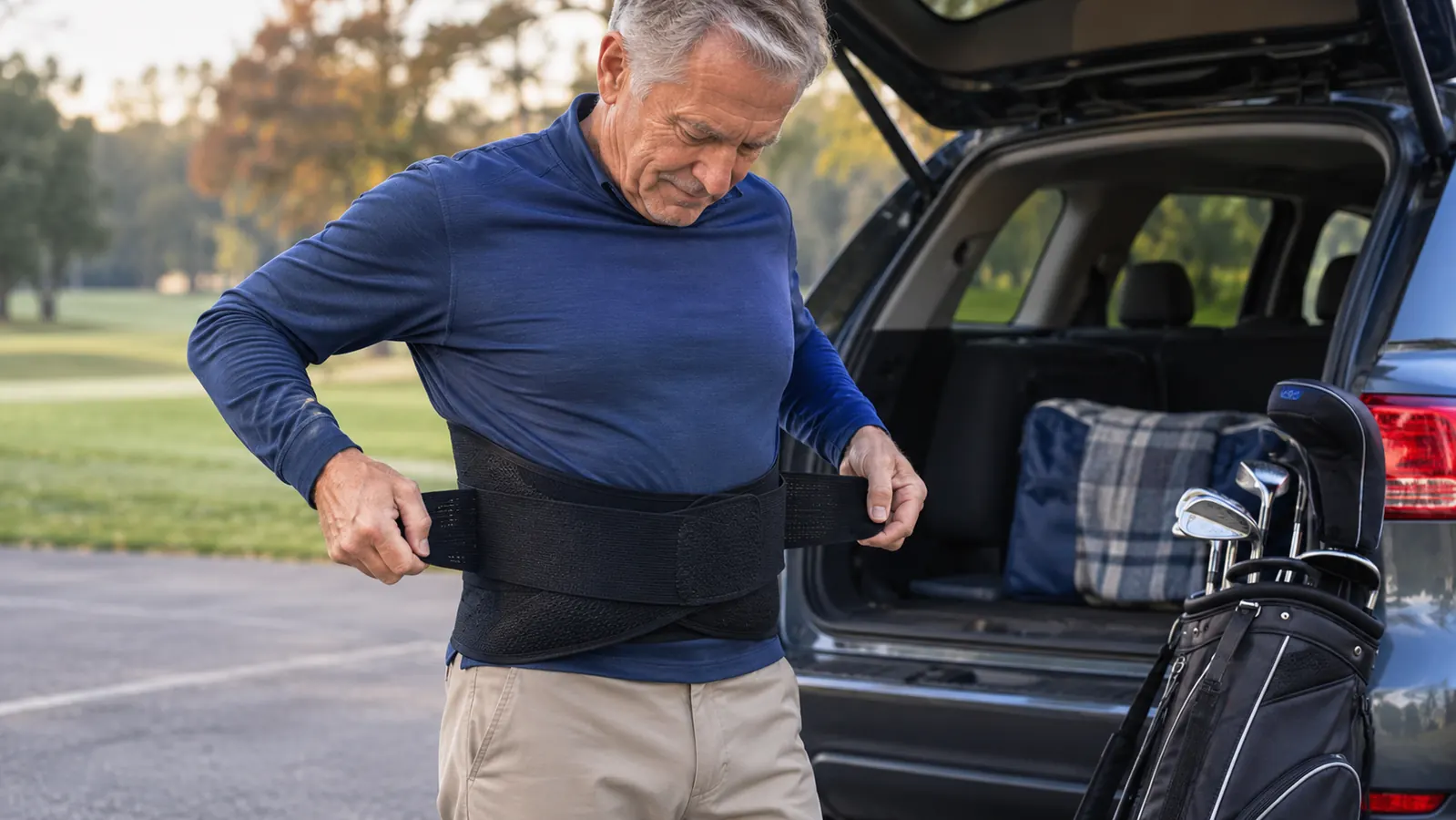
Putting it on is a two hand job. You line the panel up on the small of your back, pull the ends around, and press the closure down. Thirty seconds in the parking lot. I have done it standing at the open tailgate of the CR-V, in the rain, in the dark, and once while holding a cup of coffee, and it is not a fussy piece of equipment.
After the round it comes off in the parking lot before I fold the cart down. The cart goes in the back of the CR-V, the brace goes in the side pocket of my stand bag, and both stay there until the next cold morning. I do not wear it in the house, I do not sleep in it, and I do not wear it to the grocery store. It is golf gear as far as I am concerned, and that is the only job I have given it.
What Nobody Tells You About the Sizing
This is the part that would have saved me twenty minutes of standing in my kitchen with a tape measure if I had known it up front. You do not size this by your pants. The listing tells you to measure around the widest part of your waist, and then it gives ranges. Small covers 22 to 30 inches. Regular covers 28 to 50 inches. There is a Plus size as well. Notice that Small and Regular overlap between 28 and 30, which means some people land in two sizes and have to make a judgment call instead of a lookup.
I measured 38 inches around the widest part of my waist, which put me comfortably in the Regular with room on both ends. Eight months later, up a few pounds over the winter holidays and back down again by spring, the same Regular still fits and I am still nowhere near either end of the range. That is the value of a 28 to 50 spread. It forgives a bad winter.
One of the men in my Thursday foursome ordered one without measuring anything. He is a bigger fellow and he guessed at it, and the thing lives on a shelf in his garage now because it will not stay where he puts it. That is not the brace failing. That is a sizing problem, and it is the single most common complaint I see in the reviews, which is why I am harping on it for a paragraph and a half.
So take the measurement. Around the widest part, not where your belt sits, not your jeans size, not the number you remember from 1998. If you land right at 28 or right at 50, contact the company before you order rather than guessing. A brace that is too loose does nothing except slide around, and a brace that is too tight is miserable by the third hole.
It Is a Warm Piece of Gear, and That Matters
The material is mostly neoprene and polyester, with the steel springs and some foam in the mix, and neoprene does what neoprene does. It holds warmth. On a 45 degree March morning that is exactly what I want. It feels like a hand on my lower back. In July in east Tennessee, standing over a shot at two in the afternoon with the humidity at eighty percent, it is a different experience entirely, and I do not wear it. Not once this summer.
So the honest picture is a seasonal piece of equipment. Mine gets used from late fall through early spring and again on any cool morning in between, and that is it. It is not a year round item for anybody who walks a course in a southern summer. If you play in a dry climate or you ride in a cart all season, your mileage will differ, but for a walker in Tennessee the calendar is real and I am not going to pretend otherwise.
What I settled on is a rotation. Cool morning, base layer plus brace. Warm morning, base layer only. If the forecast is going to cross seventy by the back nine, I leave it in the bag and take my chances with my warm-up. That is not a knock on the brace. It is what a warm, stretchable garment does in the south in July, and any honest review of any brace on the market is going to tell you the same thing.
The listing also says odor resistant, and I was skeptical of that. After a season of sweating into it and then draping it over the laundry sink overnight, it does not smell like much of anything. I drip dry it and put it back in the bag. That is a small thing that turns into a big thing if you are the sort of man who leaves damp gear in a golf bag for a week, which I have been.
Thirty-five or forty rounds out of a hundred. That is the honest number, and it tells you more about this brace than any five star review on the page will.
The Four Steel Springs and the Removable Pad
Four steel springs run down the back of the brace. That is the difference between this and a wide elastic band, and it is the reason I kept wearing it after the first week. An elastic wrap squeezes. The springs push back. When I set up over the ball I can feel the panel holding the small of my back instead of just compressing it, and on a cold first tee that is worth something to me.
The first week I wore it too tight, because tight felt like it was doing something. By the fourth hole my ribs were sore and I was sorry. The adjustable closure is generous, which makes it easy to overdo. Snug, not winched. That is the whole technique, and it took me three rounds to learn it.
The pad is removable, and that matters more than the product photos let on. On a normal morning I leave it in. On a day when my back is cranky and I want pressure right at the belt line, I still leave it in but I snug the closure one notch past normal. On the handful of times I have worn the brace while sitting in the truck for a long drive, I take the pad out, because the extra bulk against the seat back is more than I want for an hour.
The whole thing weighs 16 ounces according to the listing, and that feels about right in the hand. Sixteen ounces in a golf bag is nothing at all. Sixteen ounces under your shirt for four hours is another layer, and you know it is there. I do not notice it while walking. I notice it bending down to tee a ball or pick up a wedge, mostly because it does not move with me the way a shirt does. It stays put, which is the entire point, but it is not invisible.
Eight months of use has not been gentle. The brace has ridden in a bag that gets thrown in the back of a CR-V, been sat on, been caught in the rain twice, and spent a summer in a hot garage. The stitching has held, the closure still grips, and the springs have not bent or migrated. I have bought golf gear that cost more and lasted one season. This has held up better than I expected it to.
What It Does Not Do
It does not fix your back. I want to be plain about that, because there are listings and reviews out there that blur the line. A brace is support while you do the other work. The other work, in my case, is the warm-up and stretching routine my physical therapist gave me about three years ago plus a set of core exercises my doctor told me to keep up with. The brace did not replace any of that and it was never going to.
It does not fix your swing either. I have heard men in the grill room say a back brace lets them turn through the ball again. What it lets me do is stand over the ball on a cold morning without thinking about my back, and thinking about my back is half the problem. The pro at our club is the one who looks at my swing. The brace has no opinion on it whatsoever.
And it does not replace a doctor. If your pain is sharp, or it runs down a leg, or it does not settle after a few days of rest and easy movement, put the brace back in the bag and go get looked at. My situation is ordinary wear and tightness, confirmed by somebody with a medical degree who has known me for a decade. Yours may not be, and no piece of gear sold online can tell the difference.
I will also say it does not make a bad round better. There were mornings this spring when my back was fine and I still could not find a fairway. The brace is not a swing aid and it will not save you from a slice, and if you buy it hoping for that you will be disappointed by the fourth hole.
What I Liked
- Four steel springs give firm, targeted support to the lower back instead of just squeezing it
- The adjustable closure can be backed off a notch between shots without taking the brace off
- Removable pad changes the feel of the pressure without buying anything else
- 16 ounces, light enough that it does not change how I walk a course
- The Regular size covers a 28 to 50 inch waist, so it forgives a bad winter
- Eight months of hard use and the stitching, closure and springs are all still sound
Where It Falls Short
- Neoprene holds heat, so it is a non starter on a humid July round
- Easy to order the wrong size if you use your pants size instead of a tape measure
- It is support only. It does nothing about the cause of the ache
- Not comfortable for long stretches sitting in a vehicle with the pad in
- The pad takes some fiddling to sit right under a shirt on the first try
Who This Is For
This is for the walker with an ordinary stiff lower back who wants a little support on cold mornings and does not want to think about it for the rest of the round. It is for the man or woman who has already been told by a doctor that activity is fine, and who is already doing the boring work of warming up and strengthening. It is for somebody who will take a tape measure to their own waist before ordering rather than guessing at it in front of a screen. If that is you, the MUELLER lumbar back brace does its job without fuss and without asking for credit.
It is also for the golfer who tried a plain elastic wrap and found it did nothing but roll up and bunch at the belt line. The steel springs are the difference between those two products, and it is the reason I stopped looking after the first month.
Who Should Skip It
Skip it if you play all summer in the heat and want something you can wear year round, because this is not that. Skip it if you have not seen a doctor about the pain yet, because you will spend the money and still not know what is wrong with you. Skip it if you are shopping for something that will let you stop doing the warm-up and the core work, because that is a false bargain and you will find out on the back nine. And skip it if you are going to guess at the size, since a badly fitted brace is worse than no brace at all.
One more thing, and then I will let you go. If you are looking at this to get through a round you probably should not be playing, do not do it. I have done that. It does not work out, and the brace will still be there next week when you are moving properly again.
If you are going to buy one, measure first
Around the widest part of your waist, not your pants size. Get that right and the MUELLER lumbar back brace does exactly what the listing says it does, for as long as you keep it out of the July heat.
Amazon Check Today's Price on Amazon →