

Short answer first, the way I would want it on the first tee. If you walk your rounds and you want a brace that holds a shape for eighteen holes, I would buy the MUELLER lumbar back brace. I bought mine in March 2026 for the season, and it has ridden in my bag ever since, worn on cold mornings and on the round after a sore day. The Sparthos is a real brace and a decent one. It is built for a different job than the one my back asks for on a Saturday in Maryville. One of the men in my Thursday foursome wears a Sparthos and thinks highly of it, and after watching him put it on and take it off for most of a season, I understand why. I also understand why it is not what I would strap on.
Here is where I am coming from, because it decides everything below. I am 67, retired after 34 years as a commercial airline mechanic, and I walk three rounds a week at a public course south of Knoxville. My lower back has been stiff and achy since about 60, worst on the first tee and the morning after a round. My doctor looked at it and said it is ordinary wear and muscle tightness, not a disc problem, and told me to stay active, warm up and keep my core strong. He also said a brace was fine as support while I keep up the exercises, which is the only reason I bought one. I am not a doctor, a physical therapist or a golf pro. Anything medical here came from my doctor or my physical therapist, and anything about the swing came from the pro at our club.
| MUELLER Lumbar Back Brace | Sparthos Back Brace | |
|---|---|---|
| How it supports | Four steel springs behind a removable pad, so the brace holds a shape instead of rolling up into a rope | Stretch fabric and foam working by compression, with no stays to hold a curve |
| Heat and breathability | Neoprene and polyester, which runs warm, and on a humid morning in east Tennessee it runs very warm | Breathable knit that moves air, which is the main thing the design is built around |
| Profile under a shirt | Thick enough that I plan my layers around it instead of the other way around | Slim enough that a polo hangs over it without a hard line across the back |
| Adjusting it while wearing it | The closure is adjustable, but changing it mid-round means reaching around your back and finding it by feel | A second set of straps pulls from the front, so he tightens his without undoing the band |
| Staying put over eighteen holes | I snug it in the parking lot and it is still where I put it on the eighteenth | Watching him, it needs a tug around the turn, though he rides more than he walks |
| Sizing | Sold by waist measurement, Small at 22 to 30 inches, Regular at 28 to 50, Plus above that | Also sold by waist measurement in bands, and the chart is there, just less detailed |
| Best for | Walkers who want firm, structured support on cool mornings and are willing to shed it when it warms up | Riders, warm-weather players, and anyone who wants support without bulk |
| Track record | 4.4 stars across more than 32,000 ratings | Well reviewed, with a smaller rating base that I could not compare like for like |
Where the MUELLER Wins
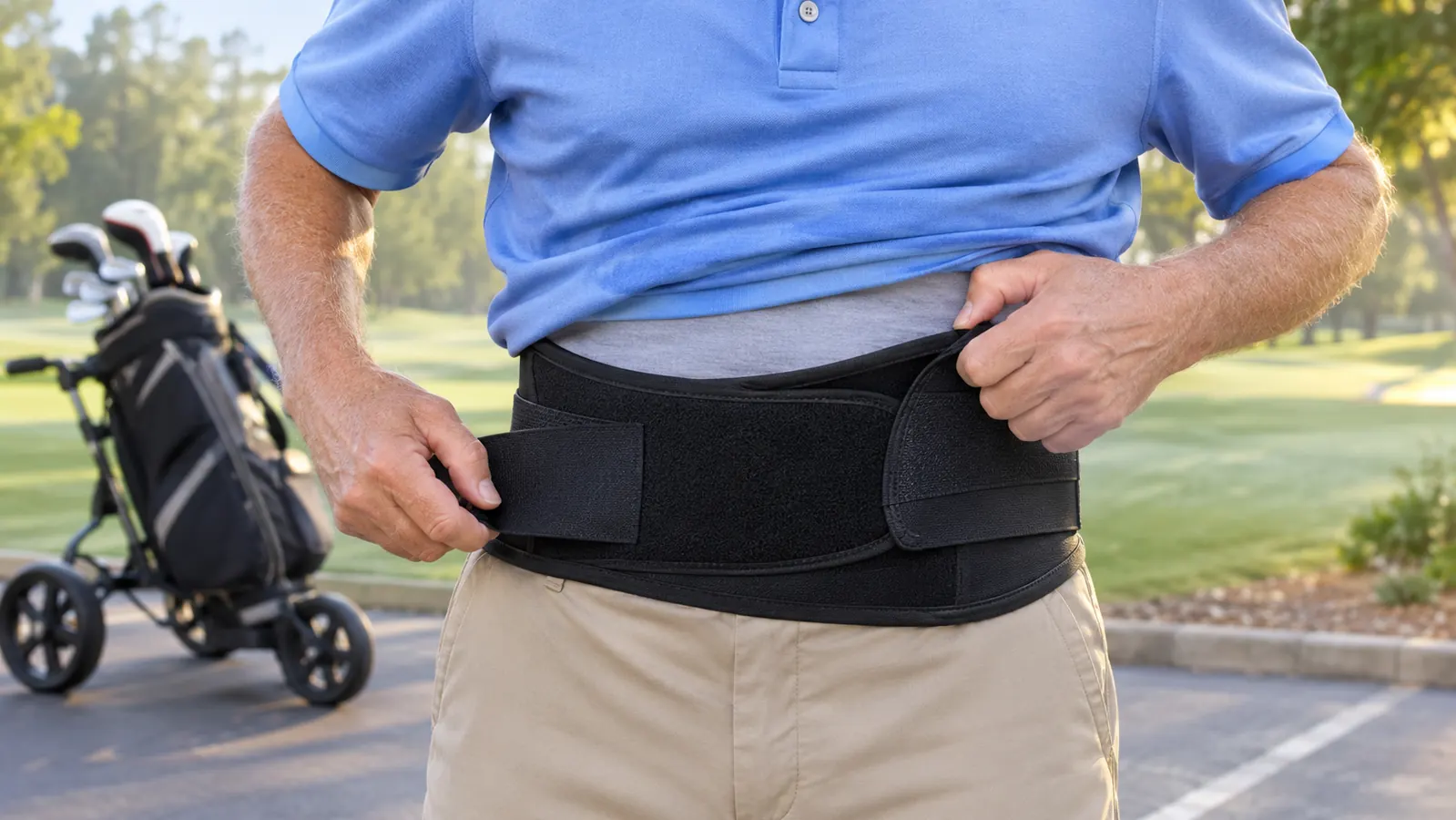
The MUELLER has four steel springs built into the back of it, and those springs are the reason I kept wearing it past the second week. A soft band gives you squeeze. This gives you a shape. When I pull it snug over a thin base layer on a 48 degree morning, it puts firm pressure across my lower back and it holds that pressure through a swing, a walk to the next tee, and another swing. The pad is removable, and mine has stayed in, because the pad is what keeps the springs from digging in when I bend over to tee a ball. That little detail is the difference between a brace you forget about by the fourth hole and one you are thinking about on every putt.
The second thing the MUELLER wins on is that it stays where you put it. I put mine on in the parking lot, set the closure once, and it is still sitting where I set it when I walk off eighteen. That sounds like a small thing until you have spent a whole round hitching at something that has crept up your ribs. Mueller has been making sports medicine gear for over 60 years, and the sizing is published plainly: Small for a 22 to 30 inch waist, Regular for 28 to 50, Plus above that. You measure around the widest part of your waist, not where you wear your belt, and you order once. I ordered Regular in March and have not thought about the size since.
Where the Sparthos Wins
Where the Sparthos wins, and wins clearly, is heat. The fabric is a breathable knit, and it moves air in a way the MUELLER simply does not. The MUELLER is neoprene and polyester, and neoprene does not breathe, it insulates. From about May through September in east Tennessee I am not wearing it past the fourth hole, and I have taken it off at the turn more than once on a muggy morning. The man in my foursome who wears the Sparthos wears his in July without complaint. If you play in real heat and you sweat through your shirt by the third green, that is a genuine advantage and I am not going to pretend otherwise.
The second win is profile. The Sparthos sits flatter under clothing, and a polo hangs over it without that hard line across the back that mine leaves. Some of that is the fabric and some of it is the missing hardware, and either way you notice it when you are standing on the tee next to somebody. The third win is the straps. From the listing and from watching him put his on, the Sparthos has a second set of straps that pull across the front, so you can snug it up without undoing the band and starting over. The MUELLER is adjustable, but adjusting it while it is on you means reaching around your back and finding the closure by feel, which is fine in a parking lot and annoying on a tee box.
The one I put on when the first tee is cold
Four steel springs, a removable pad, and a closure that is still where I set it on the eighteenth. Sizes run from a 22 inch waist up past 50. Mine has been in the bag for a full season of walking and it is not going anywhere.
Amazon Check Today's Price on Amazon →Sizing and the Mistake I Nearly Made
I nearly ordered the wrong size out of pure stubbornness. My pants are a 38, so my first instinct was to order something that matched my pants, which is not how this works. Mueller tells you to measure around the widest part of your waist, which for a man my age is a good deal further out than the waistband of a pair of slacks, and the fit ranges are wide on purpose so the closure has room to work. Small covers 22 to 30 inches, Regular covers 28 to 50, and Plus goes beyond. I took a cloth tape to myself in the kitchen in March, ordered Regular, and there is still plenty of closure left on both ends.
The other thing worth knowing is that the fit range is not the same as the comfort range. A brace that is too loose rides up. A brace that is too tight is worse than nothing because you take it off after six holes and leave it in the cart basket. My rule is that I should be able to get two fingers flat under the band before I tighten it, and then I tighten until it feels firm and stop. That is a feel thing and not a measurement, and it took me two rounds to find it. If you are between sizes on paper, the wider range on the Regular is the friendlier place to land.
I put it on in the parking lot, snug it once, and it is still where I put it on the eighteenth.

How I Judged a Brace I Never Bought
I did not buy the Sparthos, and I want to be plain about that up front. A comparison written by a man who owns both and quietly crowns one of them is not worth the paper it is printed on. What I did was read the Sparthos listing front to back, look at the size chart, and then watch a man in my foursome put his on and take it off across most of a season of Thursdays. That gives me a fair look at breathability, profile and how the straps work. It does not give me a hundred rounds of personal wear, and I am not going to claim it does.
What I can speak to first hand is the MUELLER, because it has been on my back since March 2026, on cold mornings, on the round after a sore day, and through one full walking season three times a week. I know how it holds up when I sweat through it. I know that it is still comfortable on the fourteenth hole when I have been carrying nothing but my own weight for three hours. I know where it chafes if I put it on over a cotton shirt instead of a thin synthetic layer. That is the honest split: read the table for what I saw, and read the MUELLER sections for what I lived.
What Neither Brace Does
Neither of these braces fixes a back. A brace is support, and support is a small piece of a larger routine. What has actually helped mine over the last few years is not gear at all. It is the warm-up and stretching routine my physical therapist gave me about three years ago, five minutes of slow swings in the parking lot before the first tee, and the core work my doctor told me to keep doing. The brace lets me play on a cold morning when I otherwise might sit in the car. That is the whole claim, and it is enough of a claim for me.
So the caution that belongs in every piece like this: if your pain is sharp, if it runs down a leg, if you are numb or weak anywhere, or if it has not settled in a couple of weeks, that is a conversation with your doctor and not an order on Amazon. My doctor is the one who told me a brace was fine for support while I kept up the exercises. Yours may tell you something different, and yours is the one to listen to. No brace on this page treats or heals anything, and anyone who tells you otherwise is selling, not helping.
Who Should Buy Which
Buy the MUELLER if you walk, if you play in shoulder seasons and cool mornings, and if what you want is a brace that gives you a firm, structured hold that does not move. Buy it if you have worn soft bands before and found they rolled up or crept down by the back nine. Buy it if you are willing to take it off at the turn on a hot day and put it back on for the drive home. That is my season in a sentence, and I would buy it again in March without thinking twice.
Buy the Sparthos if you play in real heat, if you ride more than you walk, or if you want support that disappears under a shirt. Buy it if you hate stopping to redo a closure and would rather pull two straps across the front and get on with it. And if you are honestly not sure, the tiebreaker is the weather. In east Tennessee in April I want the MUELLER. In August I want to be wearing the other one, or nothing at all. Neither choice is wrong. One of them just matches the way you actually play.
One brace, one season, three rounds a week
I measured my waist, ordered the Regular, and it has been in the bag since March. If you walk your rounds and want the firm hold, this is the one I would hand you on the first tee. And if your back is talking to you in a way that worries you, call your doctor before you call anybody else.
Amazon Check Today's Price on Amazon →