
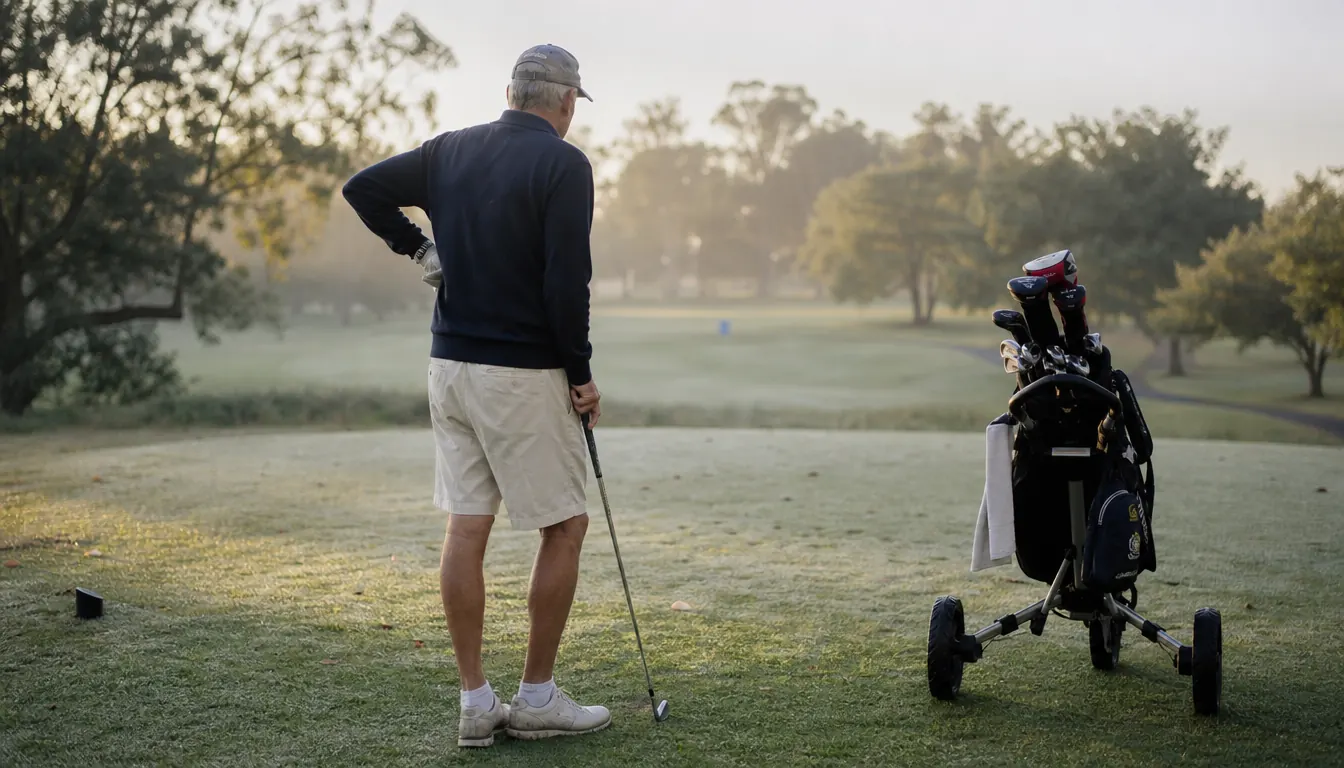
My lower back has been stiff since about age 60. It is worst on the first tee and the morning after a round. My name is Walt Ellingsen. I am 67, retired after 34 years as a commercial airline mechanic, and I live in Maryville, Tennessee, about twenty minutes south of Knoxville. I play three rounds a week at a public course near town, and I walk every one of them. My handicap is about 14, which is not good enough to blame on my back, but the stiffness is real. My doctor told me it is ordinary wear and muscle tightness, not a disc problem. He told me to stay active, warm up, and strengthen my core. I have never had back surgery or an injection. I am not a doctor, and nothing here is medical advice. If your pain is sharp, runs down a leg, or does not settle, see your doctor.
I bought a MUELLER lumbar back brace in March 2026, about eight months ago, for the 2026 season. I had never worn a brace before. I asked my doctor first, and he said a brace was fine as support while I kept up my core exercises. I do not wear it every round. I wear it on cold mornings and on the round after a sore day, snugged over a thin base layer and loosened between shots if I get warm. That is the honest way I use it, and it is the way I will explain it here. The brace is not a cure. It is a support that lets me keep walking and swinging while I do the work my doctor and physical therapist gave me.
Stiff before the first tee? Start with support, then swing easy.
The MUELLER lumbar back brace is the one I bought for the 2026 season. It has four steel springs, a removable pad, and an adjustable wrap. I wear it on cold mornings and the round after a sore day, not every round.
Amazon Check Today's Price on Amazon →Step 1: Fit the brace before you leave the house
The worst place to fit a brace is the first tee with your group waiting. I measured around the widest part of my waist at home, checked the MUELLER size chart, and ordered the Regular. The listing gives Small, Regular and Plus by waist measurement, so use a soft tape and do not guess. I did it twice to be sure. A brace that rides up or digs in will be off by the third hole, and you will be fidgeting in front of everyone.
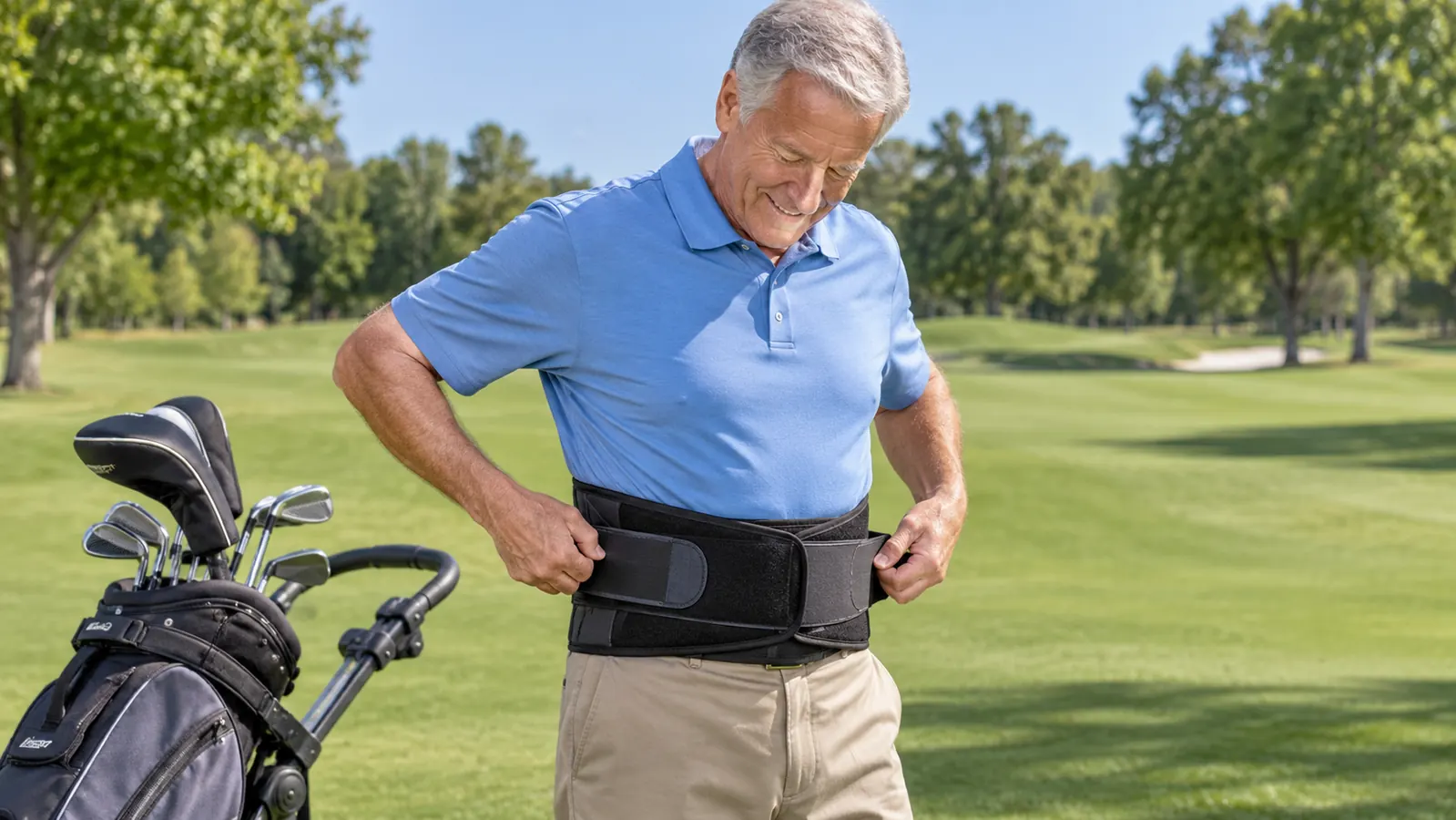
I put it on over a thin base layer, not against bare skin. The material is neoprene and polyester, and it is stretchable, so it moves with me if I set it right. The wrap is adjustable. I snug it until I feel firm pressure around my lower back and waist, then I bend side to side and take a few slow turns. If it restricts my breathing or pinches at the hip, it is too tight. Loosen it and try again. I would rather stop once at the house than fight it on the course.
The brace is 16 ounces. That is light enough that I forget it is on for a few holes, but I still check it at the turn. The four steel springs sit along the back. I want them centered over the part of my lower back that aches, not pushed off to one side. The removable pad goes where I want a little extra cushion. I leave it in on cold mornings and take it out on warmer days. I also like that the material is odor resistant, because a brace that sits against a base layer for 18 holes can get ripe. None of that is complicated, but it is the difference between a brace I wear and a brace that sits in the car.
Step 2: Warm up before you strap in, not after
My physical therapist gave me a routine about three years ago: knees to chest, gentle twists, hip hinges, and a few slow squats. I do that at home before I drive to the course. Then I do five minutes in the parking lot with the Balight swing trainer I bought in August 2026. I make slow half swings and easy turns, not full speed. The point is to wake up the muscles, not to hit shots. I see guys arrive, lace up, and take a full swing with a driver. I used to be that guy. I am not anymore.
I strap the MUELLER on after the warm-up, not before. If I put it on first, I tend to skip the stretching because I feel supported. That is backward for me. The brace is support for the round. The warm-up is what gets me ready to swing. My doctor was clear about staying active, and my physical therapist was clear about the routine. I do both. The brace just makes the first few holes more comfortable on a cold morning.
On cold mornings I also take a few practice swings with two irons together, the old way, before I pull the headcover off the driver. The swing trainer is lighter and smoother, but the two-iron swing still helps me feel my tempo. I do not force a big turn. A stiff back does not need a hero turn on the first tee. I want to be loose enough to make a normal swing, not so loose that I have worn myself out before I tee off.
Step 3: Change the swing, not just the brace
The pro at our club watched me hit balls last spring and said the brace was not going to fix a bad setup. He moved my feet a little wider, shortened my backswing, and told me to take one more club on every iron. That advice did more for my back than any piece of gear. A shorter swing with a smoother tempo puts less twist on my lower back. I still have to remind myself on the first tee, but it works.
I also stopped trying to hit the ball hard from bad lies. If I am in the rough or behind a tree, I take the club that gets me back to the fairway. The hero shot is what makes me sore. The pro called it pitching out with a purpose. I call it saving my back for the next hole. My Thursday foursome gives me a hard time about it until they see the scorecard at the end.
I take one practice swing, not three. I set up slower, check my posture, and start the club back easy. On the first tee I aim for a fairway, not a flag. The brace gives me a reminder to stay tall and not collapse at the waist. It does not swing the club for me. The pro's setup change and the brace work together, but the setup change is the part that lasts after I take the brace off.
The MUELLER is 16 ounces, with four steel springs and a removable pad. I wear it on cold mornings and the round after a sore day, not every round.
Step 4: Manage the round, especially the back nine
I walk and push the Caddytek cart, and I have since April 2025. Before that I carried my stand bag on one shoulder for twelve years, and my lower back was always worst on the back nine. The cart made a difference. The brace is another layer on cold mornings. I keep the cart in front of me, park it on the path side, and avoid bending over to pick up clubs more than I need to. Small things add up over 18 holes.
At the turn I loosen the brace for a minute. I drink water, eat something, and take a few slow turns. If it is warm and I am loose, I might take the brace off for a few holes. If the wind picks up or I feel a catch in my lower back, I put it back on. The adjustable wrap makes that easy. I do not need to take off my shirt or fight with it. That is the main reason I keep it in the bag instead of leaving it at home.
On the back nine I club up again. Fatigue makes me want to swing harder, and that is when my back complains. I pick a smooth swing and a shorter backswing. If I feel a sharp pain, I stop and call it a day. I have done that twice. A score is not worth a week of misery. The brace is there to support me, not to talk me into finishing when I should stop.
Step 5: Take care of the back after the round
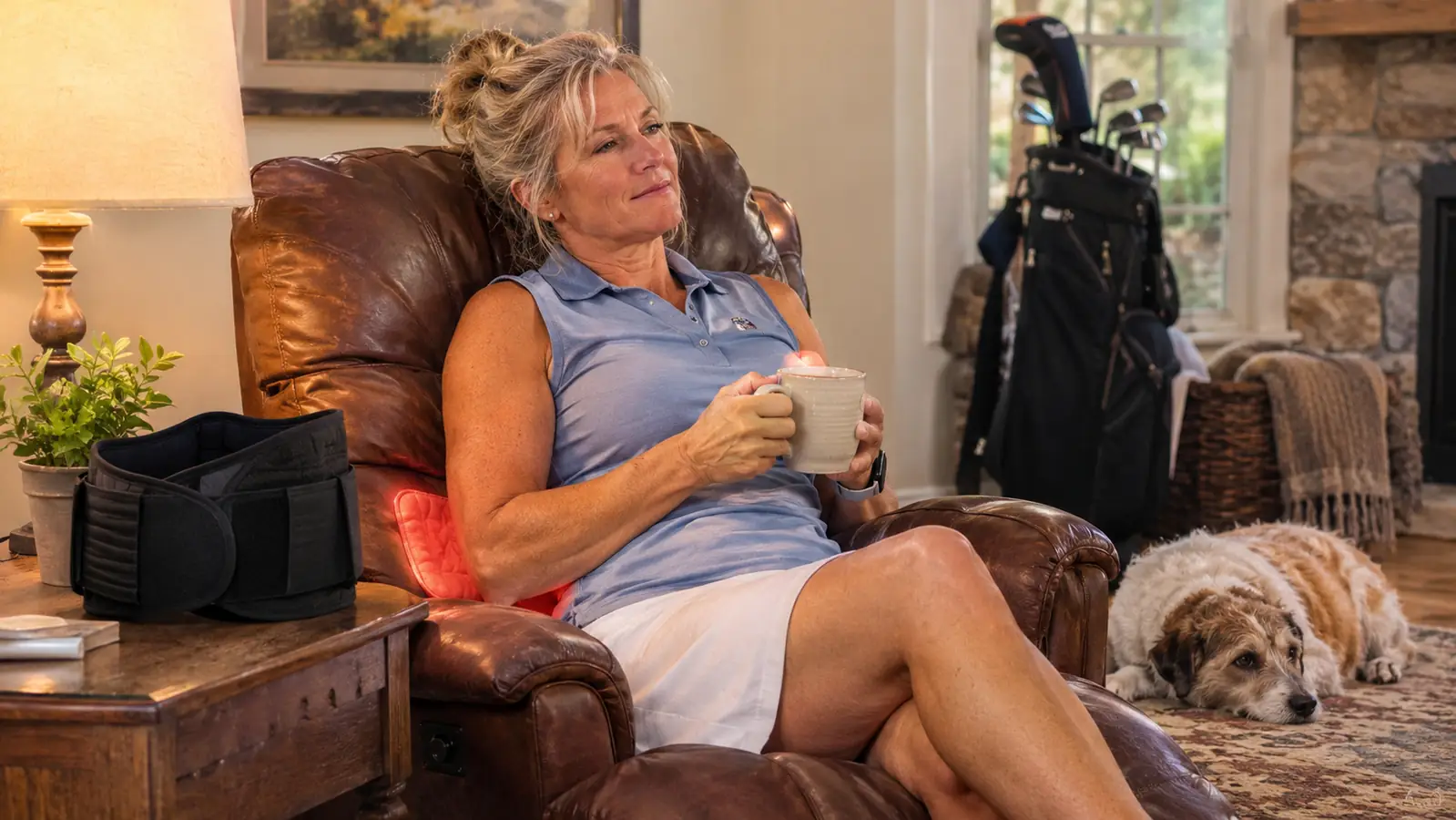
The brace comes off in the parking lot. I do not wear it home. I load the cart in the back of the 2019 Honda CR-V, change my shoes, and do a few easy stretches before I drive. At home I use the Deepsoon electric heating pad on the medium setting for 20 to 30 minutes in my recliner. I bought it in December 2025, and it has been part of my winter routine since. I never sleep on it, and I let the auto shut-off stay on. The heat helps me loosen up, and the recliner helps me slow down.
After a round I also use the MINOLL back stretcher on the living room carpet. I bought it in early October 2026, about five weeks ago, and I started on the lowest arch setting. I am on the middle one now, three to five minutes. Before that I lay on the floor with my knees bent, from my physical therapist's routine. The stretcher is not a replacement for the routine. It is just a way to get a gentle stretch after I have warmed up. I do not force it, and I do not stay on it for a long time.
I keep up with core work two or three mornings a week. That was my doctor's advice and my physical therapist's advice. The brace is not a substitute. It is support while I do the things that actually help me stay on the course. If I skip the core work for two weeks, I feel it on the first tee.
What Else Helps
The brace is one tool in a bag of them. The Caddytek cart took the load off my shoulder, and that helped my back on the back nine. The heating pad helps me loosen up after a cold round. The swing trainer gets me warm before the first tee. The back stretcher gives me a few minutes of easy extension on the floor. None of them are cures. They are habits, and the habits are what keep me walking.
The biggest help was the boring stuff. I warm up before I strap on the brace. I swing smoother. I take one more club. I walk instead of riding, because walking keeps me moving. I stop when something feels sharp. I see my doctor for checkups and my physical therapist when the routine needs a tune-up. If you are trying to play 18 holes with a stiff lower back, start with the brace fitted right, then build the round around it. The brace supports you. The routine is what carries you.
One more thing: I do not wear the brace to bed, and I do not wear it all day around the house. I wear it for golf and for the occasional cold morning when I know I will be on my feet. That is it. A brace is not a lifestyle. It is a piece of equipment for a specific job.
A brace will not cure a stiff back. It can help you walk 18 holes while you do the work.
The MUELLER lumbar back brace is the one I bought for the 2026 season. I asked my doctor first. I still warm up, swing smooth, and keep up my core exercises. If that sounds like the way you want to play, check the current price.
Amazon Check Today's Price on Amazon →