

Three months in, the Balight swing trainer lives in the back of my 2019 CR-V, next to the folded Caddytek cart and a pair of golf shoes that have seen better days. It does not live in my golf bag. That is the honest summary, and it is the part most reviews skip right past: this is a warm-up tool, not a club, and the day you start treating it like a club is the day it starts collecting dust in the garage.
I am 67, I live in Maryville, Tennessee, about twenty minutes south of Knoxville, and I walk three rounds a week at a public course. My lower back has been stiff and achy since about age 60, worst on the first tee and the morning after a round. My doctor says it is ordinary wear and muscle tightness, not a disc problem, and told me to stay active, warm up properly and keep my core strong. I am not a doctor and I am not a golf pro. I am a retired airline mechanic who spent 34 years reading manuals and testing things before trusting them. Here is what three months with the Balight actually taught me.
The Quick Verdict
A well built warm-up stick that does one job honestly. It taught me tempo and it gets me loose before the first tee, but it will not correct a slice and it will not replace the stretching routine my physical therapist gave me.
Amazon Check Today's Price →The five minutes before the first tee is where this thing earns its keep
Forty-eight inches, a textured non-slip grip, and a program of 10 to 15 minutes a day. That is the whole offer, and for a walking golfer with a stiff back it is enough.
Amazon Check Today's Price on Amazon →What Nobody Tells You Before You Buy
The first thing nobody tells you is that the 48 inch model is genuinely long. I am 5 foot 11, and stood next to my stand bag it reaches close to the top of the bag. Balight also sells a 40 inch version built for juniors and beginners, and if you are under about 5 foot 6 that is the one to get. Buying the long one because it sounds more serious is how you end up with a trainer you cannot swing indoors without clipping the ceiling.
The second thing is that the entire program is 10 to 15 minutes a day. That is it. The listing says so, and after three months I believe it. This is not a device you grind on for an hour. It is a device you pick up, swing slowly maybe twenty times, put down, and forget about until tomorrow. The men who get frustrated with it are usually the men who tried to turn it into a workout.
The third thing, and the one I most wish someone had told me, is that it will not fix anything. It will show you things. There is a real difference between those two words. A trainer like this gives you feedback by feel while you are swinging it, and then you have to carry that feel to the range and to the course. That part is on you, and on the pro at your club. I have watched a friend in my Thursday foursome swing his twice and announce that it did nothing. He also has not taken a lesson in nine years.
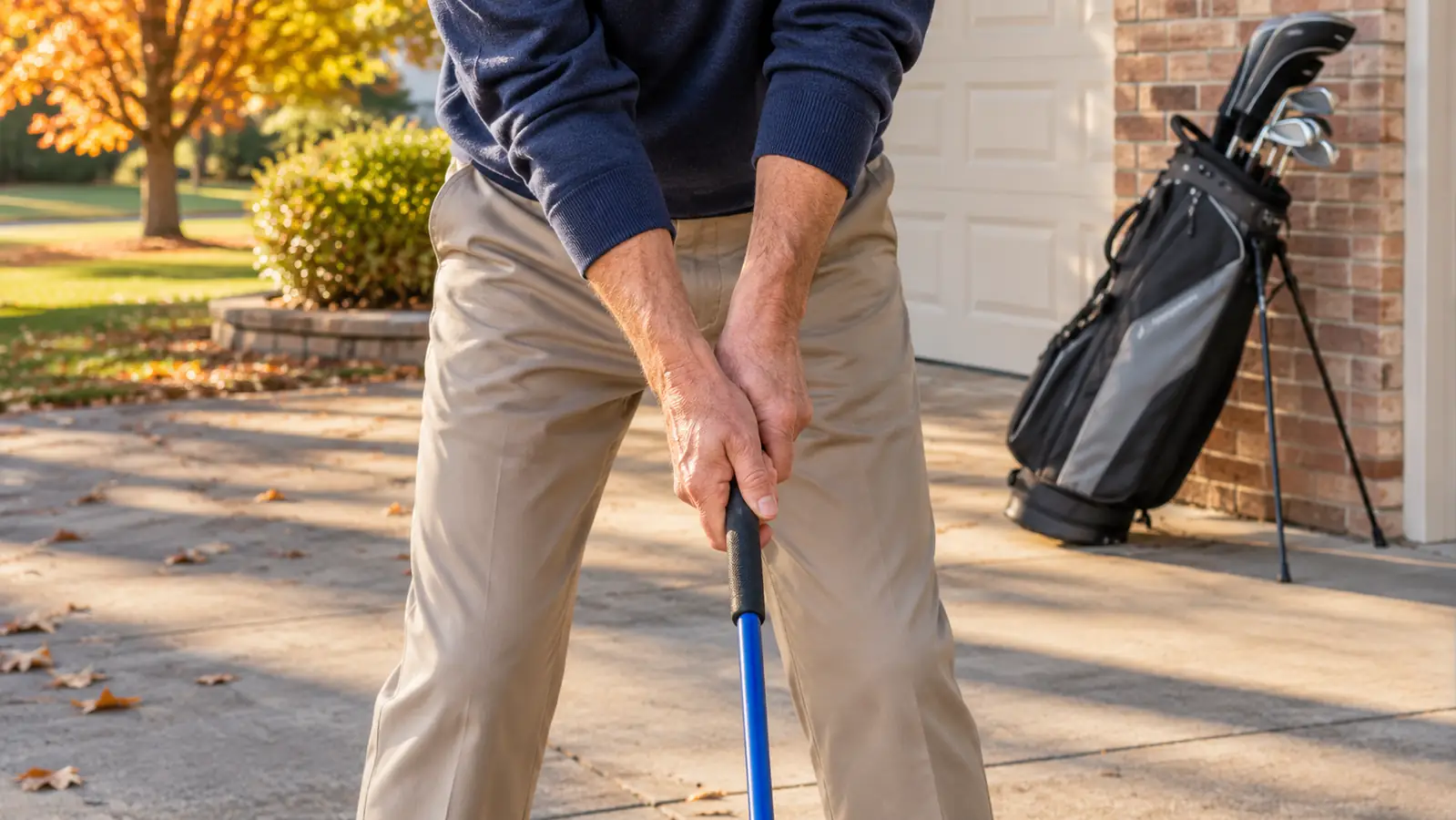
How I Actually Use It
I bought mine in August 2026, so I am about three months in. Before it, my warm-up was swinging two irons together and running through the stretching routine my physical therapist gave me about three years ago. That routine is still the main event. The Balight is what I do in the parking lot in the five minutes between pulling into the space and walking to the first tee.
The routine is not complicated. Both hands on the textured grip, feet together, and I make slow half swings back and through. Maybe ten of those, then ten more at a little more speed, then a few full turns with the trainer held across my shoulders to loosen up my upper back. Then it goes back in the CR-V and I walk to the tee. It takes longer to write down than it does to do.
I measured the walk out of curiosity the first week, because measuring things is what I did for a living. From the driver's door of the CR-V to the first tee box at our course is roughly 120 yards of asphalt and then grass, and I walk it slow. The first morning I used the trainer, in mid August, I did twenty slow swings, walked to the tee, and hit a drive dead straight about 190 yards. I have not hit a better first tee shot since, and I have been chasing that morning for three months. That is not the trainer making me a better golfer. That is a warm body making a better swing, and the trainer is just the thing that got me warm.
Some evenings I take it out on the back patio and do the same thing in the dark, mostly to keep the motion in my head between rounds. The dogs wander around while I do it. Biscuit, our golden, is convinced that any long object is a stick that needs throwing, so I have learned to do this behind the closed screen door.
It will not fix your swing. It will show you your swing. Those are two very different promises, and only one of them is true.
Tempo Is the Real Benefit, With a Catch
Here is the part that surprised me. The thing that improved most in three months was not strength, and it was not flexibility. It was tempo. When you swing something long and slow with no ball sitting in front of you, you can feel exactly where you rush. I rush from the top. I have rushed from the top for twelve years, and nobody ever got me to feel it until I spent five quiet minutes a day swinging a trainer with nothing at stake.
The catch is that the tempo you find in the parking lot does not automatically follow you to the first tee. For about the first month, I would groove a nice smooth swing in the lot and then get up on the tee and swing exactly as fast as I always have. It took most of September to make the connection. What finally helped was one thought, and only one: start the downswing at the speed I used with the trainer. That is it. One thought, every tee shot.
There is one round I keep coming back to. Third week of September, a Thursday, cold enough that I wore the brace over a base layer. I did my five minutes in the lot, then stood on the first tee and told myself the one thought. Fairway. Second hole, same thought, fairway. By the sixth I had stopped thinking about it entirely and was swinging like a man who had never heard the word tempo, and I finished that nine with two doubles and a headache. The lesson is that the feel wears off in about five or six holes unless you top it up. Now I do four or five slow swings with the trainer at the turn, standing right there beside my cart, and it holds through the back nine.
I have no idea whether my clubhead speed went up. The listing mentions clubhead speed, I have no way to measure it, and I am not going to pretend otherwise for the sake of a nicer review. My handicap has stayed around 14. What changed is that my bad shots are less wild and my back is less angry after a round, and both of those are worth more to a 67-year-old than ten extra yards.
Grip: What It Helps and What It Does Not
The grip on this trainer is a textured non-slip rubber, and it is built to be held the same way every single time. What that does is give you a consistent place to put your hands and a consistent feel for how much pressure you are using. I found out I was strangling the club. Carol could have told me that, and in fact she did, years ago, but I did not believe her until I felt it against a grip that does not shift around in my hands.
What it does not do is teach you a fundamentally different grip. It is not molded with finger grooves and it does not physically shape your hands into a neutral position. It is a training grip in the sense that it is built for repetition, not correction. If your grip is genuinely wrong, this will let you repeat the wrong grip more consistently. That is a real limitation and it is the one I would want to know about before buying.
The morning stiffness deserves its own note. I have stiff, arthritic hands, which my doctor says is ordinary for a man who spent 34 years with a wrench in them, and on a cold morning my fingers do not want to close. There was a stretch in October where I could not get the club settled in my left hand on the first tee to save my life, and I was blocking everything right. What I do now is pick up the trainer before I touch a real club and just hold it. Not swing it. Hold it, open and close my hands on that textured grip six or eight times, and let the fingers wake up. That is not a swing fix. It is a fix for cold hands, and it is the reason the trainer stays in the car all winter instead of going on the shelf with the other gadgets.
Where it earns its place is pressure. Grip pressure is something I can actually control, and the trainer gives me a clear reminder of what light pressure feels like before I pick up a real club. That alone is worth a few minutes a day to me, and it costs me nothing but time.

The Limits, Straight Up
It will not fix a slice. It is not a hinged training club and it does not force you onto a plane. If your problem is an out-to-in path with an open face, this trainer will happily let you practice that path very smoothly for ten minutes a day. Nobody sells a stick that fixes a slice, and any review that tells you otherwise is selling you something.
It is also not a medical device, and I want to be plain about that. My doctor told me to stay active and warm up. My physical therapist gave me a routine three years ago that I still do three or four times a week. The Balight did not treat my back and it did not heal anything. What it did was get me to warm up more consistently, and warming up more consistently is a thing my doctor actually asked for. That is the honest size of it.
The other limit is your ceiling and your patience. At 48 inches, you cannot use this in a room with a standard ceiling unless you choke down and make half swings. I tested it anyway, because I did not believe the reviews. Our den has a standard eight foot ceiling, I choked down about a hand's width, made three quarter swings, and the tip just barely cleared on the way back. I could feel it pass close enough to the paint that I was not going to keep doing it. Carol came in, watched one swing, and asked me to take it outside. She was right. If you have vaulted ceilings or a garage with the door up, you are fine. In a normal room with a normal ceiling, you are making half swings whether you planned to or not.
The warranty is one year, which is standard and unremarkable. The materials are rubber and a rubber composite shaft, so there is nothing in it that is likely to fail dramatically. Mine has three months of parking lot use on it, including a few cold October mornings and one week where it sat in a hot car, and the grip still feels like the grip. I have no complaints about how it is built.
What I Liked
- Teaches tempo better than anything else I have tried, because there is no ball to chase
- The textured non-slip grip gives a consistent pressure reminder every morning
- Ten to fifteen minutes a day is a program you will actually keep
- Two lengths, 48 inch for adults and 40 inch for juniors and beginners
- Held up to three months in a hot car without the grip breaking down
Where It Falls Short
- It will not correct a slice or a swing path, and it does not pretend to
- The 48 inch length is too long for indoor use under a normal ceiling
- It repeats whatever grip you already own, good or bad
- Some men will expect a strength workout and get a warm-up instead
- It is not a medical device, so do not buy it hoping it treats back pain
Who This Is For
This is for the golfer who already plays, already knows roughly what a good swing feels like, and needs something to get loose and find tempo before a round. Especially if you walk the course. Especially if you are over 60. Especially if the first tee is where both your back and your swing tend to go bad. It rides in the car next to a folded push cart and takes up no more room than an alignment stick.
It is also a reasonable buy for a beginner playing twice a month who wants a feel for the motion without hitting balls in the dark. The 40 inch version is the one for that golfer, and it is the only sensible choice for a junior. I would not hand a 48 inch trainer to a 10-year-old and expect anything but a broken lamp.
Who Should Skip It
Skip it if what you want is a fix. If your issue is a slice, a hook, an early extension or a flat shoulder plane, you need the pro at your club and a bucket of balls, not a stick. Skip it if you are after a strength tool, because ten to fifteen minutes of slow swinging is a habit, not a workout, and it will build consistency long before it builds muscle.
And skip it if your back pain is sharp, or radiates down a leg, or does not settle after a few days of rest. Go see a doctor. I say that as a man with a bad back and not one bit of medical training. A swing trainer is not going to sort out a nerve, and swinging through that kind of pain is how a bad week turns into a lost season.
Five minutes in the parking lot beats a stiff first tee every time
I have had this thing in the back of my car for three months and I still use it before every round. If you walk three times a week and your back complains about it, this is the cheapest five minutes you will spend on your golf game.
Amazon Check Today's Price on Amazon →